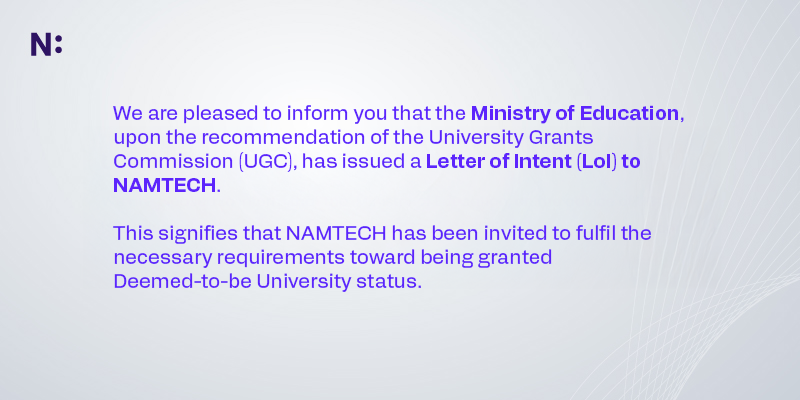
Announcements
The car you drive today has more in common with a smartphone than it does with a car from 2005.
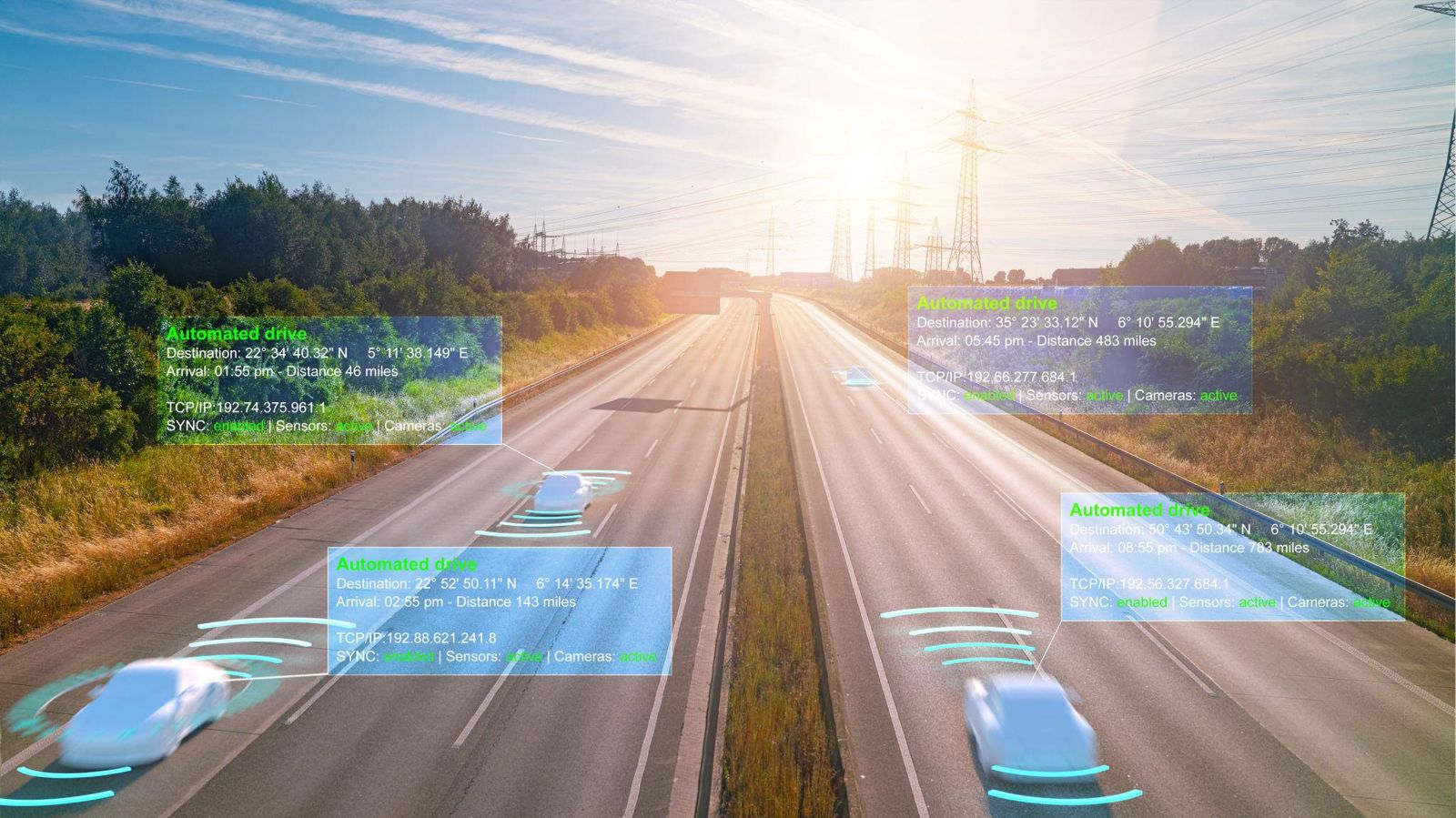
It runs on millions of lines of code. It gets software updates overnight. It has sensors that read the road, cameras that detect pedestrians, and a battery system managed by algorithms running thousands of calculations per second. In many new models, the engine itself is gone — replaced by electric motors, power electronics, and a battery pack that has to be kept within a precise temperature range to function safely.
This is not a future scenario. It is what is rolling off production lines right now. And it is fundamentally changing what it means to be an automotive engineer.
The industry is changing faster than engineering education has caught up
For decades, automotive engineering was a clearly defined field. You understood engines, transmissions, chassis, and materials. The skills were deep but relatively stable. A mechanical engineer from 2000 could, with some upskilling, still do meaningful work on a car from 2015.
That is no longer true.
A modern electric vehicle is built on a completely different technical foundation. The battery alone — managing cell voltage, temperature, and charge state in real time — runs on software that has to meet the same safety standards as flight-critical code. The electrical architecture that connects everything is now closer to a data center than a car. And the systems that keep the vehicle in its lane, brake before a collision, or navigate autonomously require engineers who work across sensors, computer vision, and embedded software at the same time — not sequentially, but simultaneously.
A 2024 study by SIAM and Deloitte found that only 27% of skills from traditional internal combustion engine engineering carry directly over to EV roles. Nearly half the technical competency map is new ground. The industry needs roughly 200,000 directly skilled EV professionals by 2030 — and currently adds about 15,000 a year.
That gap is not going to be filled by retraining the existing automotive workforce. It has to be built from scratch.
What this means for engineers entering the field now
If you are graduating with a degree in mechanical, electrical, electronics, or mechatronics engineering, you are entering a market where the demand for the right skills significantly outpaces the supply of people who have them.
The roles that are hardest to fill — and compensate accordingly — are not the ones that sit neatly inside a single discipline. Battery systems engineers need to understand electrochemistry, thermal management, and embedded software. ADAS engineers need to work across sensors, computer vision, and functional safety standards. Systems integration engineers need to hold the whole vehicle architecture in their head and make it work as one.
These are not niche specializations. They are the core of what building a modern vehicle requires. And they command a premium because most engineers coming out of conventional programs are not trained for them. Mid-career specialists in battery management, power electronics, or ADAS are already earning ₹16–40 lakh per annum — salary bands that would have been associated with senior software roles a decade ago.
The comparison to software is not accidental. In the late 1990s and early 2000s, software engineering had a similar quality — a field where demand was growing faster than the education system could respond, where the engineers who got in early and built the right skills shaped careers that compounded for decades. EV engineering is at a structurally similar point. The technology shift is real, the investment is committed, and the talent gap is measurable. The engineers who build cross-domain expertise now will be the ones leading teams, designing platforms, and defining the field in ten years.
What building that expertise actually look like –
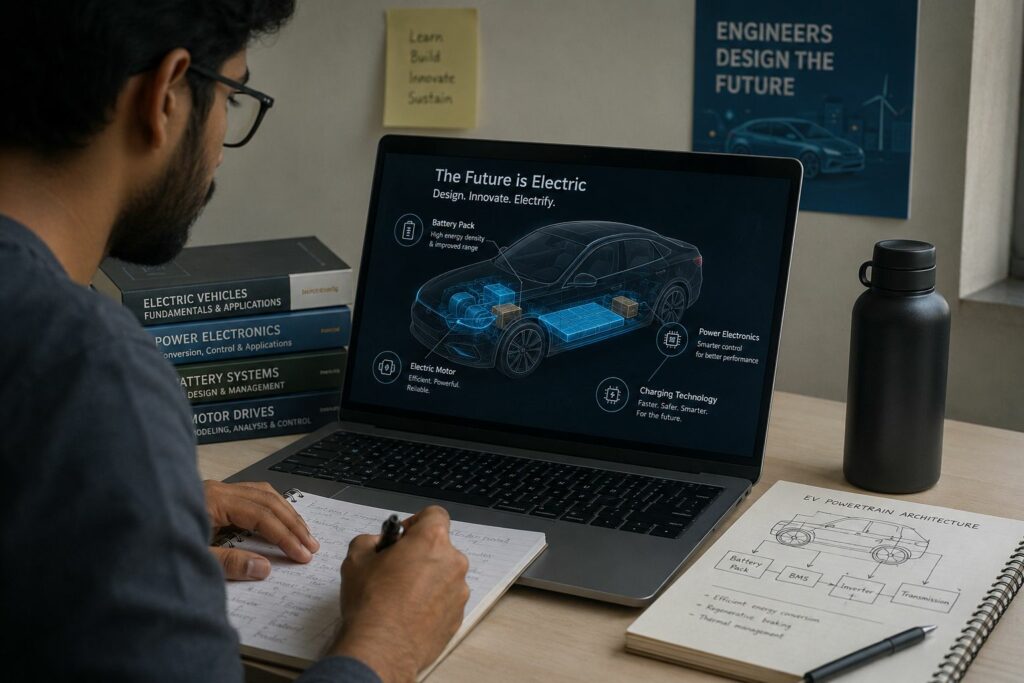
The cross-domain nature of EV engineering is the challenge — and the opportunity. It cannot be solved by adding one elective or attending a certification workshop. It requires structured exposure to battery systems, power electronics, embedded software, vehicle dynamics, manufacturing, and management — built together, not separately.
NAMTECH’s Center of Excellence in Automotive Engineering was designed specifically around this gap. The two-year Master in Automotive Technology and Management — next cohort beginning August 2026 — covers the full stack that modern EV engineering demands: hybrid and electric vehicle systems, battery management, power electronics, ADAS and autonomous systems, software-defined vehicle architecture, automotive cybersecurity, and AI-driven diagnostics. It also covers manufacturing systems and management, because the engineers who lead in this sector will need to operate across technical and operational boundaries, not just inside one.
The curriculum was developed with The Center for Advanced Automotive Research at IIT Madras. Labs are being built in collaboration with ARAI — the Automotive Research Association of India, the body that certifies vehicles for Indian roads — giving students hands-on access to industry-grade testing and validation environments. Structured industry immersion at Gravton Motors in Hyderabad puts students inside a working EV company. Global immersion runs through TUM Asia in Singapore and the Technical University of Munich in Germany, two of the most respected automotive engineering institutions in the world.
Placement partners include Honda, Volvo, Exide Energy, Schneider Electric, and Bosch Rexroth — companies that are actively building EV capability and hiring engineers who can contribute to it from day one.
In 2024, a NAMTECH team won India’s first-ever medal in the Industry 4.0 category at WorldSkills — the international skills competition held every two years with competitors from nearly 90 countries. The bronze was for a project involving digital twin technology, cloud computing, and smart manufacturing systems. That outcome is not incidental. It reflects what happens when students are trained on the actual technical problems the industry is trying to solve.
The automotive industry is going through the most significant technical transformation in its history. The vehicles being designed and built today are fundamentally different from those of ten years ago — and the engineers who build them need to be too.
The skills gap this creates is not a problem that will resolve itself. It will be closed by engineers who deliberately prepare for it.
The window to be among the first through it is open now.
NAMTECH (New Age Makers’ Institute of Technology) is an educational initiative by ArcelorMittal Nippon Steel India and India’s first dedicated Manufacturing Engineering Technology institution. Applications for the Master in Automotive Technology and Management — August 2026 batch — are open at namtech.ac

08 June, 2026