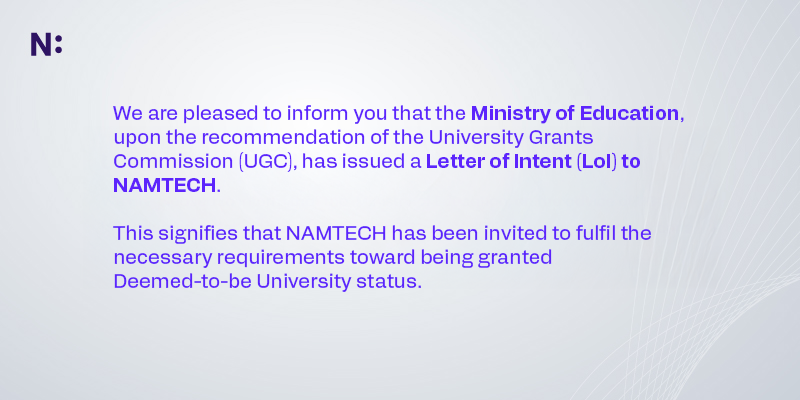
Announcements
For the first time in decades, the conditions are genuinely in place. Semiconductor fabs are being built on Indian soil. Intelligent EV production lines are scaling. Industrial robot installations hit a record 9,120 units in 2024, putting India sixth in the world (IFR World Robotics 2025). FDI into Indian manufacturing rose 18% to US$19 billion in FY2024-25. The National Manufacturing Mission, announced in Budget 2025-26, has set a clear target: manufacturing at 25% of GDP, 143 million jobs, and US$1.2 trillion in exports by 2035.
India’s manufacturing decade isn’t a projection. It’s already underway.
But building semiconductor infrastructure, intelligent EV ecosystems, and AI-driven industrial systems at this scale requires something that policy and capital alone can’t provide: engineers who can lead them. Not just engineers who can execute — engineers who understand technology deeply enough to drive it and understand business well enough to scale it.
That’s a different kind of engineer. And India is only just beginning to produce them.
The Engineer India Actually Needs Right Now
India graduates roughly 1.5 million engineers every year. Most of them are technically trained for a world that is rapidly changing beneath their feet. Smart factories don’t just need people who understand machines — they need people who can integrate AI-driven systems, manage autonomous production lines, lead cross-functional teams, and make decisions at the intersection of engineering and business strategy.

This profile has a name: the techno-manager.
It’s the core concept behind Manufacturing Engineering Technology — MET — a category of engineering education that India’s traditional institutions were never designed to produce. MET sits at the convergence of intelligent systems, advanced engineering, and emerging technology. A MET-trained engineer doesn’t choose between technical depth and leadership. They operate across both.
NAMTECH — New Age Makers’ Institute of Technology, India’s first MET Institute — was built specifically to produce this engineer. Founded in 2023 by ArcelorMittal Nippon Steel India and operating from the Research Park at IIT Gandhinagar, NAMTECH offers seven two-year master’s programs designed around one question: what does India’s next wave of technology-driven industries actually need its engineers to be able to do?
The answer is built into every program — Smart Manufacturing Technology and Management, Semiconductor Manufacturing Technology and Management, Robotics Engineering and Management, Sustainability Engineering and Management, Automotive Technology and Management, Heavy Industry Engineering and Data Analytics and AI. Each maps directly to a sector where India’s industrial build-out is already happening, and where the demand for qualified leaders is growing faster than the supply.
India’s semiconductor industry alone is projected to face a shortfall of 250,000 to 300,000 professionals by 2027 (TeamLease Degree Apprenticeship, 2024). The EV sector is expected to generate more than 10 million direct jobs by 2030 (IVCA-EY). Robotics, intelligent automation, industrial AI — every sector that sits at the core of India’s ambition is competing for the same scarce pool of engineers who can think and lead at this level.
What Makes NAMTECH Different
The curriculum is 100% experiential, built around three learning principles that set it apart from conventional postgraduate engineering education.
The first is competency-based learning. At NAMTECH, the measure of progress isn’t courses completed — it’s skills mastered. Every learner moves through personalized pathways that build technical depth, professional capability, and leadership competency in parallel. The result is measurable, demonstrable readiness — not a transcript.
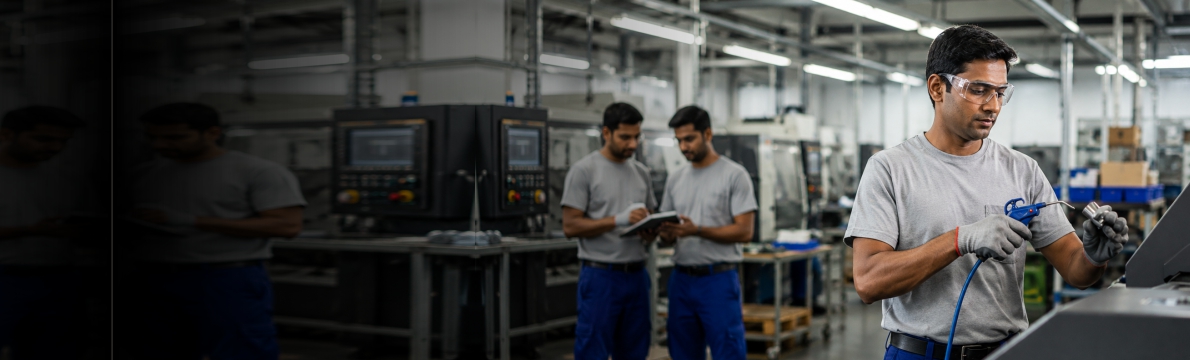
The second is project-based learning. Every student solves real engineering problems through hands-on projects co-designed with industry partners. Inside NAMTECH’s on-campus smart labs and micro-factories, theory doesn’t precede practice — they happen simultaneously. Students graduate having already delivered impact, not having studied it.
The third is competition-based learning. Learners take on challenges and industry competitions that mirror real-world scenarios — pushing them to think critically, collaborate under pressure, and innovate beyond the obvious. It’s the kind of environment that doesn’t just train engineers; it builds engineers who raise the bar.
This pedagogy is backed by partnerships with globally benchmarked institutions and more than 50 industry partners — companies that co-design curriculum, provide faculty from the field, and recruit directly from NAMTECH’s graduating cohorts, including Siemens, ABB, Schneider Electric, FESTO, Micron, Analog Devices, Rockwell Automation, FANUC, and L&T Heavy Engineering. NAMTECH reports 100% placement across its first two graduating batches, with an average package of ₹8.1 LPA and a highest package of ₹16 LPA.
A six-month industry immersion and a global module are built into the program structure — because NAMTECH’s definition of ready isn’t theoretical. It’s day-zero.
The India MET Scholarship: Talent Is the Only Entry Requirement
A program this intensive has a cost. NAMTECH’s two-year master’s is priced at ₹13.2 lakh, inclusive of tuition and residential fees.
The India MET Scholarship exists to make sure that number doesn’t become the deciding factor in who gets to be part of this.
Every student who earns admission receives a scholarship. The floor is 50%. The ceiling is 75% — and for several categories of students, that 75% is automatic.
| Eligibility | Scholarship |
| All girl students | 75% |
| EWS students (family income ≤ ₹8L per annum) | 75% |
| GATE qualified students | 75% |
| IIT / NIT / IIIT / IISER / BITS graduates | 75% |
| Students from Northeast states, HP, Uttarakhand, J&K | 75% |
| Composite score 80+ | 75% |
| Composite score 70–80 | 70% |
| Composite score 60–70 | 65% |
| Composite score below 60 | 50% |
The scholarship design reflects something important about how NAMTECH thinks about access. Women are underrepresented in postgraduate engineering — the absolute number of women in PG engineering programs in India fell 43% between 2013-14 and 2021-22 (Ministry of Education, AISHE). GATE qualifiers — fewer than one in five candidates who appear actually qualify (IISc Bengaluru, GATE 2024) — have already proven they belong at the postgraduate level. Students from Northeast India, Himachal Pradesh, Uttarakhand, and Jammu & Kashmir are given priority access to programs anchored in the intelligent systems and advanced engineering industries most likely to define their regions’ economic futures. EWS students aren’t asked to prove anything beyond their financial situation.
None of these categories are afterthoughts. Each is a deliberate signal about who NAMTECH believes should be in the room.
How to Apply
Applications for the August 2026 cohort are open. The deadline is 30 May 2026. Seats are limited.
Four steps:
- Apply online at admissions.namtech.ac
- Application review by NAMTECH
- Appear for interview
- Receive offer letter and confirm
Minimum eligibility: B.Tech / B.E. with 60% aggregate in Class 10, Class 12 and graduation. No active backlogs. Accepted entrance scores: GATE / CAT / XAT / GMAT / GRE.
The scholarship is assessed at admission — you don’t apply for it separately. If you qualify, it applies.
Education loan tie-ups are available with Axis Bank, ICICI Bank, HDFC Credila, and Equaid.
Apply for the India MET Scholarship →
India is building something it hasn’t built before. The intelligent systems going live across the semiconductor corridors of Gujarat, the EV ecosystems of Maharashtra and Tamil Nadu, and the autonomous infrastructure taking shape across India’s industrial landscape will need engineers who are ready to lead them from day one.
The India MET Scholarship is how NAMTECH makes sure the only thing standing between you and that opportunity is what you can do.

29 June, 2026