Announcements
India has committed, in policy and in capital, to becoming a manufacturing power. The National Manufacturing Mission, announced in the 2025–26 Union Budget, sets the objective of raising manufacturing’s share of GDP to 25% by 2035 and generating 143 million jobs in the process. These are ambitions rather than achievements, and the distinction matters — but they are ambitions now backed by measurable movement. The Production Linked Incentive scheme had, by August 2024, attracted approximately ₹1.46 lakh crore in actual investment and supported around 9.5 lakh jobs, according to the Department for Promotion of Industry and Internal Trade.
The ambition is real. So is the obstacle standing in its way, which is not capital or policy but people.
The gap, stated precisely
A manufacturing sector of the scale India envisions requires a workforce trained to run it. On current evidence, that workforce does not yet exist in sufficient numbers. Manpower Group’s 2024 Talent Shortage survey found that 81% of Indian employers reported difficulty filling roles — nearly four in five, and close to double the figure of 2021. This is not a marginal shortfall. It is a structural gap between the talent the economy is producing and the talent its ambition demands.
The gap is sharpest in the sectors central to the manufacturing mission. The semiconductor industry alone is projected to face a shortage of between 250,000 and 300,000 professionals by 2027, according to a Team Lease analysis reported in mid-2024, spanning research, design, fabrication, and advanced packaging. A country building fabrication plants at speed cannot staff them from a talent pool that does not yet exist at the required scale.

Why the gap exists
The shortfall is not primarily one of numbers. India produces a very large volume of engineering graduates each year. It is a shortfall of readiness, and the data on employability makes this visible — though it must be read carefully, because the leading measures disagree.
The India Skills Report 2025, produced by Wheebox with the Confederation of Indian Industry, places national employability at 54.81%, with engineering graduates at 71.5%. The Mercer-Mettl India Graduate Skill Index 2025, drawing on more than a million students across 2,700-plus campuses, arrives at a markedly lower overall figure of 42.6%. The two use different methodologies and should not be merged into a single number. Read together, however, they support the same conclusion: a substantial share of graduates are not, at the point of graduation, ready for the roles industry needs to fill.
The reasons are well documented — curricula that have not kept pace with automation, data analytics, and digital manufacturing; limited hands-on and live-project exposure; and an assessment of readiness that arrives, if at all, too late to correct.
Closing the gap is the opportunity
For an individual graduate, a structural talent gap is not a warning. It is an opening. A sector with high demand and thin qualified supply is precisely the sector in which a well-prepared entrant faces the least competition and commands the most leverage.
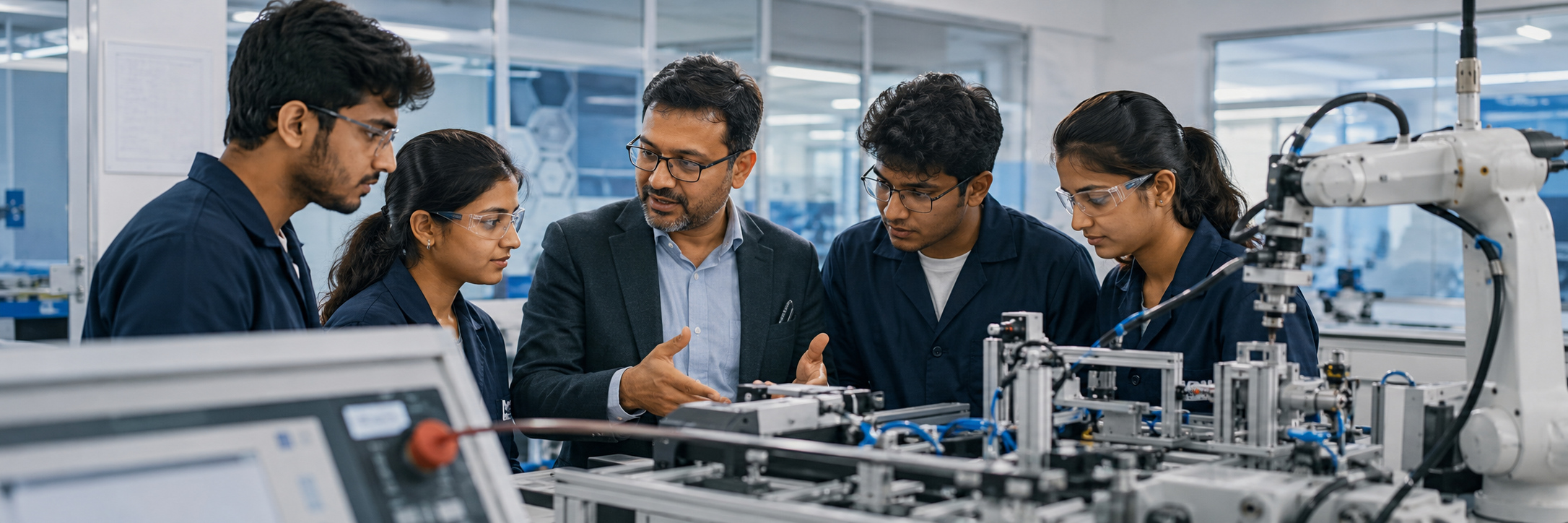
This is the gap NAMTECH — a not-for-profit initiative by ArcelorMittal Nippon Steel India — was established to close. Its two-year techno-managerial master programs are built around the readiness the sector lacks: a heavily practical model delivered through on-campus micro-factories and industry-grade laboratories, culminating in a six-month capstone conducted inside a real company. The design responds directly to the diagnosis. If the gap is one of applied readiness, the remedy is training that is applied from the outset.
Factories can be built. Technologies can be imported. Policies can accelerate growth. But none of them create manufacturing capability without people who know how to build, operate, and improve them. As India’s manufacturing ecosystem expands, the engineers who combine technical depth with practical readiness will not simply find jobs—they will shape the future of the industry.

31 July, 2026