Announcements
Most engineers do not choose a postgraduate program. They inherit one. The senior who cleared GATE says M.Tech. The batchmate with a consulting offer says MBA. The relative abroad says MS. Each recommendation is sound in isolation, and none of them is about the person receiving it. This is how a decision that shapes a decade gets made on the logic of whoever spoke last — and it is the single most common way engineers end up in the wrong program.
The trap is not choosing wrongly between good options. It is choosing by the name of the credential rather than the career it opens.
The question almost nobody asks first
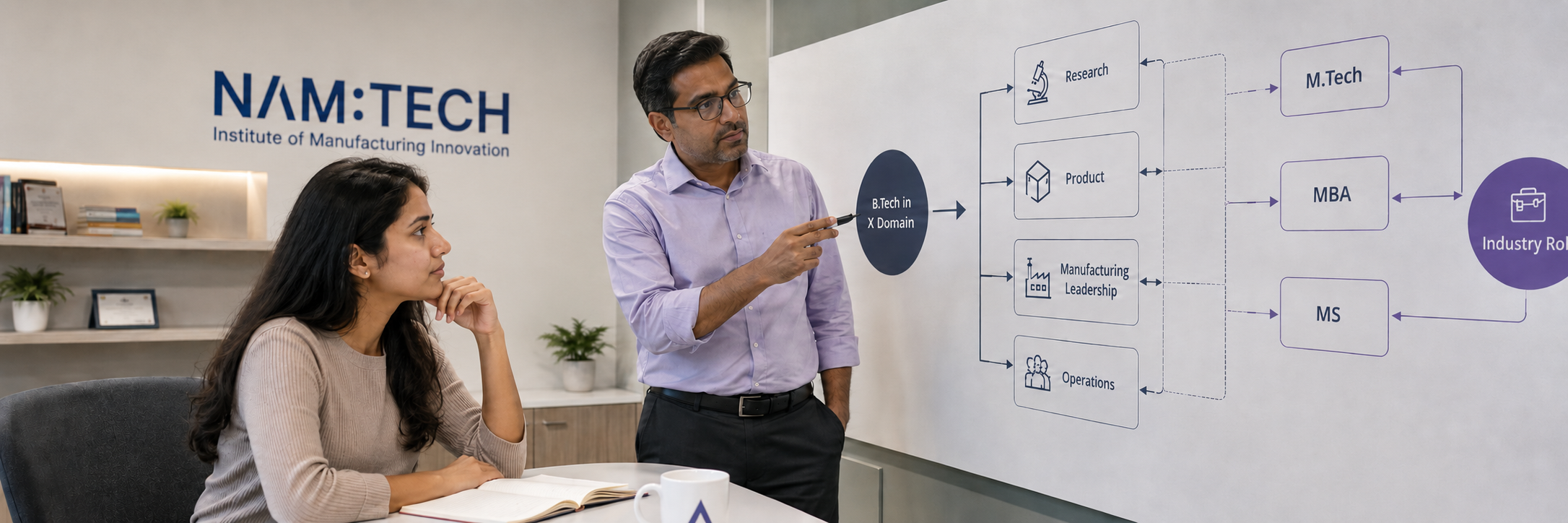
A postgraduate degree is a two-year commitment of time, money, and opportunity cost. The reasonable way to evaluate it is to work backward from the outcome: what work do I want to be doing, and which program most directly leads there? Yet the typical decision runs forward from the credential — M.Tech because it is respected, MBA because it pays, MS because it is abroad — and only afterward asks what that credential actually leads to. By then the fee is paid and the two years are committed.
This matters more now than it did a decade ago, because the ground under these credentials has shifted. The World Economic Forum’s Future of Jobs Report 2025, which surveyed over a thousand employers, found that 39% of the core skills required in a given job are expected to change by 2030. A credential chosen for its name, rather than for the specific capabilities it builds, is a bet that the name will still carry weight when the skills beneath it have moved. That is a weaker bet than it appears.
An M.Tech is the strongest route for someone genuinely oriented toward research, deep technical specialisation, or an academic and public-sector-undertaking career, particularly through a strong GATE score. It becomes a trap when it is chosen as a default — a way to postpone the job market for two years without a specific technical direction in mind.
An MBA is the right instrument for someone drawn to strategy, product, or general management. It becomes a trap when it is treated as an escape hatch from engineering, or as a mechanism for a salary increase without a corresponding change in the kind of work the person wants to do.
An MS abroad offers the highest ceiling and carries the highest cost and risk. Its return is excellent for those who secure and retain employment overseas, and considerably weaker for those who return to India immediately, having spent between sixty lakh and well over a crore. It becomes a trap when the destination is chosen for its prestige rather than for a realistic assessment of where the person intends to build a life.
Note the pattern. In each case the program is not the problem. The mismatch between the program and the person is the problem, and that mismatch is produced by choosing on the basis of the label.
The way out of the trap

The alternative is unglamorous but reliable. Define the work first. Identify the roles that genuinely interest you, examine what those roles actually require, and then select the program that builds precisely those capabilities. When the decision is anchored to an outcome rather than a credential, the confusion tends to resolve on its own.
This is the logic behind NAMTECH — the New Age Makers’ Institute of Technology, a not-for-profit initiative by ArcelorMittal Nippon Steel India. Its two-year techno-managerial master programs are organised around specific industry roles rather than around a generic degree title, pairing engineering depth with management capability and a six-month industry capstone so that graduates enter the workforce with demonstrated, applied experience. NAMTECH reports 100% placement record across its two graduating batches, with a class average of 8 lakh and a highest package of 21 lakh. The point is not that this is the right program for everyone. The point is that it was designed backward from the outcome — which is the correct direction from which to make the choice, whatever a candidate ultimately selects.
The engineers who avoid the postgraduate trap are rarely the ones who deliberated hardest over which credential carried the most prestige. They are the ones who first decided what they wanted to build, and then let that decision select the program.

18 July, 2026