Announcements
Every country has a moment that sticks with it. Germany’s Wirtschaftswunder, or “economic miracle,” rebuilt a country that had beendestroyed. The rise of chaebols turned rice paddies into semiconductor fabs in South Korea. A statement by a senior Chinese leader, “toget rich is glorious” changed China’s economy and the world economy by freeing up its manufacturing power.
India is having its time right now.
You can feel it in any electronics factory in Noida, any car factory in Chennai, or any precision engineering unit in Pune. The hum of what could be. The power of change. Young engineers are writing code for robots that work in factories. Technicians in charge of smart assembly lines. Designers are making things that will have the “Made in India” label on them in stores from Detroit to Dubai. This is more than just growth in industry. It’s a whole new way of thinking about what India can be and can achieve.
The Flywheel That Makes Everything Different
Prime Minister Narendra Modi often says that India is going “from job-seeker to job-creator.” But there is a deeper truth in those words. Manufacturing isn’t just one part of the economy. This flywheel is what gets everything else going.
Think about how a flywheel works. It takes a lot of energy to get it going at first. But once it gets going, it can keep going on its own, making power that spreads out. The economy of a growing country works in a similar way.
The numbers tell a story of endless potential. India could add 1.5 to 2 percent to its GDP growth every year if it invests heavily in Manufacturing, Engineering, and Technology (MET). But this is where it gets interesting. Every dollar put into manufacturing doesn’t just make one dollar of value. It generates $2.45 in economic activity throughout the entire ecosystem.
Think about what that means for people. People who work in a new factory don’t just work there. It creates jobs for truck drivers to move goods, engineers to fix machines, accountants to keep track of money, canteens to feed workers, housing to shelter families, and schools to teach their kids. One job in manufacturing could lead to five, ten, or even twenty jobs in related fields.
If India leads on the manufacturing front, it could create 50 to 70 million new formal jobs between now and 2040. Not just any job, but jobs in electric vehicles, cutting-edge electronics, defence technologies, aerospace innovation, and advanced automation. These are jobs that pay well and give you respect.
But every chance has a dark side. India’s GDP contribution from manufacturing stays below 17 percent of its potential, and without a strong push, growth becomes empty, which economists call “jobless expansion.” This means that the economy grows on paper, but young people have a hard time finding good jobs. Almost 10% of India’s young people could see their skills become useless before they even start working.
The stakes couldn’t be higher.
The Human Element: Skills Are the New Money
This is what keeps business leaders up at night. India will need to retrain and teach new skills to 140 million workers by 2030. That’s about how many people live in France and Spain together. The size is huge, but so is the chance.
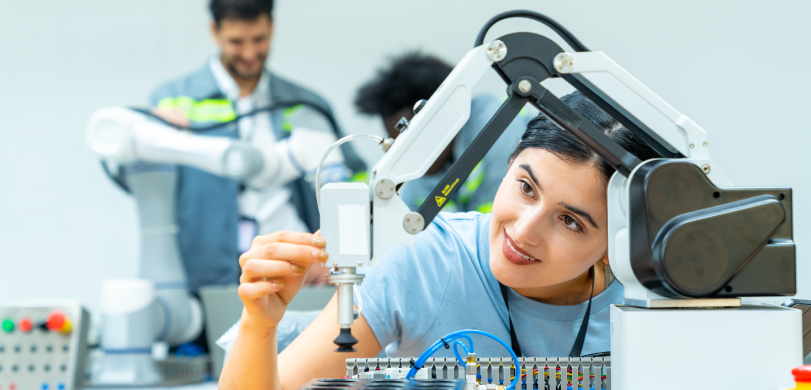
These days, factories don’t have assembly lines where workers do the same thing for eight hours. It’s about professionals who know how to work with robotics, program PLCs (programmable logic controllers), mix data science with mechanical engineering, and work well with AI systems and cobots (collaborative robots).
This is where the study of human behavior and the changing of industries come together. People don’t like change, especially when it feels like it could hurt them. It’s normal to be scared. Will robots take over my job? Will all of my years of experience suddenly mean nothing? Will I be left behind?
But fear is a bad way to find your way in the future. The truth is more complicated and much more hopeful. Technology doesn’t take the place of what people can do. It makes it stronger. A skilled worker and a cobot can make ten times as much as either of them working alone. An engineer with AI-powered analytics can fix problems that would take months to fix in a matter of hours. A technician who knows how to do predictive maintenance can stop problems before they happen, which saves millions of dollars.
It’s not a battle between people and machines. It’s people working with machines to make things happen that neither could do alone.
But if companies don’t actively invest in skills development, the gap between what they need and what workers can offer grows into a chasm, and companies will have a hard time growing. Even though the GDP is going up, talented young people are still out of work. The promise of growth led by manufacturing has not yet come true.
Going Global: From Being a Part to Leading
India’s strong manufacturing base gives it a lot of power around the world. If India stays focused, its share of global manufacturing exports could reach about 5% by 2040. Electronics exports alone could go over $15 billion, making India a strong competitor in semiconductors, medical devices, and green energy technologies.
The timing is perfect. Global companies are actively pursuing “China+1” strategies in order to spread out their manufacturing operations. This isn’t just planning for a company. It’s a chance knocking. Apple, Micron, Renault-Nissan, and GE Aerospace are not just visiting India. They are putting money into things, building things, and making long-term commitments.
But they aren’t coming for cheap work. Those times are gone. Global giants are now after skilled workers, innovative ecosystems, and strategic advantages, and India needs to send not just workers but also top-notch professionals who can compete with anyone, anywhere.
The other option is scary. India is stuck exporting goods like cotton and gems because it doesn’t have any factories. It needs to buy important technologies like semiconductors and defence systems from other countries, and it is always trying to catch up in a global economy that is getting more complicated.

The Green Imperative: Be a Leader, Not a Follower
This is where India can completely change the rules of the game. Smart, sustainable manufacturing can cut emissions from factories by 20 to 30 percent and even make them more productive. Factories that follow the rules of the circular economy, use renewable energy, and make the most of their resources don’t just follow the rules. They turn into advantages in the market.
Consider how people think about global markets. More and more, people choose products based on their values and not just their features. A “Made in India” label that means not only quality but also caring for the environment is very powerful. Countries that set standards for sustainability and then work to meet them have more power than their size would suggest.
India’s commitment to Net Zero by 2070 isn’t just an environmental pledge. It’s a plan for the economy. India is a leader in the technologies that will shape the next century because it makes things in a way that is good for the environment. These include clean mobility, renewable energy integration, and sustainable materials science. But this door won’t stay open forever. The Carbon Border Adjustment Mechanism of the European Union is already in place, not something that will happen in the future. Countries that don’t meet green manufacturing standards will see their markets close, their chances of success shrink, and their costs go up.
The Choice Before Us
Manufacturing is India’s flywheel. Once it gets spinning, everything accelerates, and Jobs multiply. Exports soar. Sustainability becomes achievable while GDP growth compounds. Global leadership becomes inevitable.
But flywheels require initial force. They demand commitment, investment, and belief. Most importantly, they require skilled people who can turn possibility into reality. The manufacturing revolution is already here. The question isn’t whether India will participate but how India will lead.
The future belongs to makers and innovators. Nations that bet on their people will have a bright future.
India owns that future.

Designation : Director - Brand & Communication
02 December, 2025