Announcements
Semiconductor talent demand in India is rising, but it is not one uniform hiring wave. It is three different talent markets—chip design, wafer fabrication, and packaging + testing—each with its own tools, workflows, and expectations of “job-ready” ability.
Semiconductor engineering roles in India have historically skewed toward design. What is changing now is the scale-up of manufacturing and packaging capacity, which expands hiring into process, equipment, yield, reliability, quality, and production test. If you understand how these lanes connect, you can plan your skills and training with far more clarity—and avoid the common trap of preparing “generically” for a very specific industry.
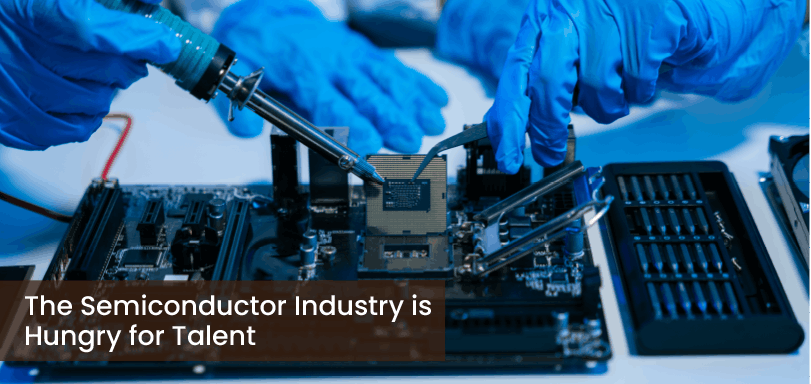
1. Semiconductor talent demand in India is splitting into three hiring lanes
Semiconductor talent demand in India is easiest to understand when you map it to the semiconductor lifecycle:
- Design: Define and build the chip’s functionality (logic, architecture, integration).
- Fabrication: Manufacture the chip on silicon with controlled, repeatable processes.
- Packaging + testing: Assemble, validate, screen, and ship parts that meet quality and reliability targets.
Semiconductor workforce readiness in this context is not a buzzword. It simply means you can enter one lane and contribute correctly—by following the workflow, producing measurable outputs, and maintaining discipline around documentation and quality.
2. Semiconductor engineering in design: The largest and most mature demand pool
Semiconductor engineering hiring in India remains strongest in design because design teams scale through engineering throughput—how quickly they can build, verify, and close a chip against aggressive schedules.
Semiconductor skills that matter in design roles are also relatively visible to employers. A candidate can demonstrate readiness through portfolios, code, project artifacts, and clear documentation.
2.1. Semiconductor talent demand in India for Register-Transfer Level ( RTL)/Digital Design
Semiconductor talent demand in India for RTL is driven by the need for engineers who can translate requirements into clean, synthesizable logic—and write in a way that others can review, reuse, and integrate.
Semiconductor skills that signal readiness here include: strong digital fundamentals, clean RTL style, interface clarity, and an ability to think in terms of corner cases rather than “happy path” behavior.
2.2. Semiconductor engineering in verification: The quality gate before silicon
Semiconductor engineering demand is consistently high in verification because verification directly reduces risk. A chip that fails in the field is far more expensive than a bug found in simulation.
Semiconductor skills that help you stand out include: structured verification thinking, debugging discipline, coverage awareness, and the habit of writing test intent clearly (not just producing wave forms).
3. Semiconductor technologies in physical design and sign-off: Where shortages feel acute
Semiconductor technologies come into sharp focus in physical design because this is where logical correctness meets electrical and physical constraints—timing, power, routing congestion, IR drop, electromigration, and sign-off closure.
Semiconductor talent demand in India for physical design remains strong because closing a design is not just “knowing tools.” It is learning the closure loop: diagnose >> adjust constraints or implementation >> re-run >> validate >> document.
Semiconductor skills that employers look for here include: timing concepts, constraint discipline, sign-off awareness, and comfort with iterative closure work under tight timelines.
4. Semiconductor engineering in DFT and post-silicon validation: Testing starts early
Semiconductor engineering roles in DFT and validation are valuable because they connect design intent to production reality. Design teams want chips that can be tested efficiently, and production teams need test strategies that scale.
Semiconductor talent demand in India in this area often grows when teams feel pressure to reduce escapes, improve coverage, and speed up bring-up cycles.
Semiconductor skills to develop include: testability fundamentals, debug mindset, and the ability to move between “design view” and “failure signature view” without losing rigor.
5. Semiconductor manufacturing in India: Why fabrication changes the hiring mix
Semiconductor manufacturing in India creates a different kind of talent demand because manufacturing work is driven by precision, stability, and process discipline. In a fab, consistency is a competitive advantage—and mistakes can be costly.
Semiconductor talent demand in India on the manufacturing side expands rapidly when facilities move from setup to ramp, because a production line needs teams across process, equipment, metrology, facilities, and quality—not just a small set of specialists.
Semiconductor skills that matter here include: clean room discipline, safety awareness, documentation habits, and comfort with structured troubleshooting.
6. Semiconductor engineering in process, equipment, and facilities: The fab backbone
Semiconductor engineering in process roles focuses on achieving stable, repeatable outcomes at scale. Process engineers do not just “run experiments”—they define process windows, control variation, and improve yields while protecting reliability.
Semiconductor technologies in equipment and facilities roles are equally critical. Tools must stay calibrated and stable.Utilities—gases, chemicals, ultra pure water, HVAC—must be tightly controlled. These teams are often the difference between a smooth ramp and chronic downtime.
Semiconductor workforce readiness for these roles usually comes from applied exposure: labs, structured operating procedures, and hands-on understanding of measurement and control.
7. Semiconductor skills in yield, reliability, and failure analysis: The “data-to-decision” roles
Semiconductor skills become especially valuable when they translate into yield improvement and reliability confidence. Yield engineering is where data meets manufacturing reality, and reliability engineering is where quality is protected over the product’s life.
Semiconductor manufacturing in India will require more of these “detective” roles as production scales, because the fastest way to reduce cost and improve delivery is often yield and cycle-time improvement—not just higher capacity.
Semiconductor talent demand in India in this domain typically rewards engineers who can:
- Analyze patterns without jumping to conclusions
- Correlate failures across steps
- Propose fixes that are practical to implement
- Document decisions clearly for cross-team alignment
8. Semiconductor technologies in packaging and testing: The scaling opportunity (ATMP/OSAT)
Semiconductor technologies in packaging and testing are where chips become shippable products. Packaging is no longer a “back-end detail”—it influences performance, thermal behavior, reliability, and cost.
Semiconductor talent demand in India is expanding in ATMP/OSAT and test because these operations scale with production volume.
When throughput grows, so does demand for engineers who can maintain quality, improve test coverage, and reduce false fails and escapes.
Semiconductor engineering roles you will commonly see here include:
- Packaging process engineering
- Assembly and line engineering
- Production test engineering (including test program optimization)
- Quality and reliability roles tied to shipped performance
Semiconductor skills that stand out include: methodical debugging, measurement discipline, and strong reporting—because packaging and test teams live on traceability and repeatability.
9. Semiconductor engineering courses in India: How to choose training that leads to roles
Semiconductor engineering courses in India vary from theory-heavy to industry-aligned. The right choice depends on the lane you want: design, fab, or test/packaging.
Best courses in semiconductor engineering typically share three characteristics:
- Applied learning that mirrors real workflows (not only lectures)
- Role clarity (process vs equipment vs test vs design tracks)
- Industry exposure through projects, internships, or lab environments that simulate operational discipline
Semiconductor workforce readiness improves fastest when learning produces evidence: a project artifact, a design/verification deliverable, a yield mini-study, a test debug write-up, or a structured process improvement report.
Where NAMTECH fits in this talent landscape
Semiconductor talent demand in India is increasingly balanced across design and manufacturing tracks, and many candidates find the biggest gap is not knowledge—it is hands-on readiness and role fit.
Semiconductor engineering learners who want manufacturing-facing roles often benefit from programs designed around fabrication, packaging, testing, and operational discipline—especially when they include structured labs and real industry exposure. NAMTECH’s semiconductor programs are positioned to support this kind of readiness-building, particularly for candidates targeting semiconductor manufacturing in India and production-linked roles.
Final takeaway
Semiconductor talent demand in India will reward candidates who stop preparing in broad strokes and start preparing with role clarity. Design, fab, and test are connected—but they do not hire the same profile.
Semiconductor skills become employable when they are visible as outputs: clean work, structured thinking, documented decisions, and an ability to operate within real constraints. If you pick a lane, build evidence, and train with applied depth, you move from“interested in semiconductors” to “ready for semiconductors”—which is exactly what this industry screens for.

10 March, 2026