Announcements
Here’s something nobody says out loud in semester 8: most B.Tech students don’t choose a path after graduation. They follow one.
Someone in their batch gets an IT services offer and takes it. Someone else starts GATE prep because their elder sibling did. A few apply for MS programs abroad because that’s what the toppers always do. Very few people sit down, look at the actual options, run the numbers, and decide.
This guide is for the person who wants to stop and actually think. It won’t tell you what to do. It will give you what you need to figure it out yourself — real data, honest tradeoffs, and a clear framework for making the call.
The Reality Nobody Tells You First
India produces roughly 1.5 million engineering graduates every year. Per Team Lease, only about 10% are expected to secure employment in a given year. The Unstop Talent Report 2025 found that 83% of 2024 engineering graduates had not received a job or even an internship offer. Even IIT placement rates fell from 90% in 2021–22 to 80% in 2023–24.
The IT services sector reduced fresher hiring from 600,000 in 2022 to under 150,000 in 2024. Meanwhile, Global Capability Centres plan to boost fresher hiring by 40%, and manufacturing — backed by PLI schemes — shows 82% fresher hiring intent.
The market isn’t shrinking. It’s restructuring around people with specific, applied expertise. That single shift is the most important context for every decision that follows.

Five Paths After B.Tech — And What Each One Actually Returns
1. Take a Job Now
The most underrated option. You start earning immediately, learn what industry actually looks like from the inside, and figure out what you want before spending money on a degree.
The honest downside: a generic IT services offer at ₹3–3.6 LPA is a training stipend, not a career launchpad. TCS and Infosys entry-level pay has been effectively flat for years. If you take a job, the goal is to convert it — within 18–24 months — into a specialized role in AI/ML, cloud, cybersecurity, or whichever sector you want to build depth in. Taking a job and staying on the commodity track is where the real risk lies, not in taking the job itself.
2. M.Tech
A two-year technical specialization entered via GATE. The cheapest premium option on this list. Total cost at an IIT: ₹2–4 lakh, often partially offset by a GATE stipend. Average starting salaries range from ₹8–12 LPA, with IIT CSE and AI M.Tech programs reaching ₹18–22 LPA.
One thing nobody writes honestly: the degree name is the same across institutions, but the outcome isn’t. An M.Tech from a premier institution delivers research exposure, industry credibility, and placement. Before choosing an M.Tech anywhere, look at their placement data for the last two years — not just the headline figure. M.Tech is the right path if you genuinely enjoy technical depth, want R&D, or are aiming for a PhD.
3. MBA
Two years, entered via CAT/XAT/GMAT. Best top-end ROI if you get into the right place: an IIM-A MBA at roughly ₹25 lakh returns ₹30–35 LPA in year one. That math is exceptional. An MBA from a tier-2 school at ₹18 lakh returning ₹9 LPA takes over three years just to break even — before accounting for the salary you didn’t earn during those two years.
MBA suits engineers who want to move into consulting, product management, operations, or general management. Work experience before an MBA improves both your admission odds and what you get out of it.
4. MS Abroad
The path with the highest ceiling and the widest spread of outcomes. The most important thing to understand: the country you pick should follow from your engineering discipline — not the other way around.
Robotics: Germany or Japan. Germany hosts the world’s third-highest robot density per the IFR World Robotics 2025 report (449 robots per 10,000 employees), with companies like KUKA, Siemens, and Bosch actively hiring, and near-zero tuition at public universities. Japan records the world’s highest robot density (1,220 per 10,000) and is home to Fanuc, Yaskawa, and Toyota — ideal for deep industrial robotics specialization.
Semiconductors: Netherlands or USA. The Netherlands (ASML, NXP) is the most accessible EU entry point for chip design and process engineers. The USA pays the most — Nvidia, Qualcomm, Intel — but carries H-1B lottery risk.
Renewables: Germany, Denmark, or Australia. Germany’s Energiewende drives the largest EU demand for energy and grid engineers. Renewables provided 55.1% of German electricity in 2025. Australia pays renewable engineers AUD 86K–154K and provides a PR pathway under ECTA for Indian graduates.
Aerospace: USA or France/UK. The US BLS reports a median aerospace engineer salary of $134,830 with 6% employment growth projected to 2034. France (Airbus HQ) and the UK (Rolls-Royce, BAE Systems) are the leading EU options — though defence roles often require clearances that limit access for Indian nationals.
AI/software: USA for pay, Canada for visa certainty. The US has the deepest concentration of AI companies and highest salaries, but H-1B is a 35% lottery. Canada’s Global Talent Stream processes work permits in ~2 weeks and offers a clear 3-year PGWP-to-PR pathway.
Civil/infrastructure: Saudi Arabia and UAE. NEOM and Vision 2030 megaprojects are actively recruiting Indian civil and structural engineers at tax-free salaries of SAR 12,000–40,000/month. Indian engineers have long been well-represented in Gulf construction; proximity and cultural familiarity are genuine advantages.
MS Abroad — Quick Reference:
| Country | Tuition | Post-Study Work | Avg. Eng. Salary | Best For |
| Germany | Near-zero (public unis) | 18-month Job Seeker Visa | €40K–€55K | Robotics, auto, renewables, Industry 4.0 |
| Canada | CAD 16K–49K/yr | PGWP up to 3 years | ~CAD 96K | AI/software, energy, PR pathway |
| Australia | AUD 28K–50K/yr | 2–3 yrs + 1 yr ECTA bonus | AUD 75K–95K | Mining, civil, renewables, tech |
| UK | £15K–30K/yr | 2 yrs (18 months from Jan 2027) | £35K–£50K | Aerospace, rail, fintech |
| Netherlands | €15K–25K/yr | 1-yr Orientation Visa | €40K–€55K | Semiconductors, tech |
| Singapore | SGD 25K–45K/yr | No post-study visa — must land EP | SGD 48K–72K | Biomedical, finance, tech |
| USA | USD 25K–60K/yr | OPT 1yr + STEM-OPT 2yrs (under review) | USD 80K–120K | AI, semiconductors, aerospace |
One important comparison: India is closing the gap. Before committing to an MS abroad, run the actual numbers. €45,000 in Germany, after 35–40% taxes and high living costs, leaves significantly less discretionary income than ₹20 LPA in India on a purchasing-power basis. GCCs now employ 2.36 million people in India at a 12–20% salary premium over IT services. The question of “should I go abroad” is no longer as one-sided as it was five years ago.
On the US specifically: A September 2025 presidential proclamation introduced a one-time USD 100,000 fee on new H-1B petitions, currently under legal challenge. F-1 visas issued to Indians fell 43.5% in H1 FY2025. The US still leads for elite research and frontier AI roles — but factor in the policy risk before choosing it as your primary plan.
5. Specialized, Industry-Aligned PG Programs
A growing fifth path that most career guides ignore entirely — covered in its own section below.
Where the Jobs Actually Are in 2026
| Sector | India Demand Signal | Fresher Salary (India) | Best Country Abroad |
| Semiconductors | 250K–300K professionals needed by 2027 | ₹6–12 LPA | Netherlands / USA / Taiwan |
| AI & Data | 1.25M roles by 2027; 60–73% supply gap | ₹6–12 LPA | USA / Canada / UK |
| Renewable Energy | Hiring grew 23.7% YoY in 2024 | ₹4–8 LPA | Germany / Australia / Denmark |
| Defense & Aerospace | Exports hit ₹23,622 Cr in FY25 (+12%) | ₹4–8 LPA | USA / France / UK |
| Space Tech | 400+ private space startups by 2024 | ₹5–10 LPA | USA / Germany |
| Cybersecurity | 1M+ professional shortage; 25–30% demand growth | ₹4–7 LPA | UK / Canada / USA |
| Fintech | 150K–200K talent shortfall in India | ₹5–10 LPA | UK / Singapore / Canada |
| Infrastructure | ₹11.21L Cr capex in Budget 2025–26 | ₹3–5 LPA | Saudi Arabia / UAE / Australia |
| Biomedical/Medtech | Market projected $50B by 2030 | ₹3–6 LPA | USA / Germany / Singapore |
| IT (specialist tracks) | GCCs: 2,117 centres, $98.4B revenue | ₹6–21 LPA (specialist) | USA / Canada / UK |

Why Specializing in a Booming Sector Changes Everything
Robert Half’s 2026 Salary Guide found that 87% of tech and IT leaders pay higher salaries to candidates with specialized skills over generalists in the same role. This isn’t just an IT phenomenon — it holds across every engineering discipline.
A mechanical engineer with deep expertise in smart manufacturing and industrial robotics enters a market where 2.4 million manufacturing positions are projected unfilled by 2028. A civil engineer with infrastructure project management skills enters a sector with ₹11.21 lakh crore in active government capex. An ECE graduate who understands semiconductor fabrication enters a market that needs 250,000–300,000 trained professionals by 2027 and is finding them nowhere.
For AI and data specifically, NASSCOM data shows demand-supply gaps of 60–73% for ML engineers, data scientists, and data architects. These roles aren’t competitive — they’re going unfilled.
The pattern is the same across sectors: deep expertise in a shortage domain gets you hired faster, paid more, and promoted earlier. A generalist B.Tech graduate competing for the same roles as 1.5 million others faces a fundamentally different market than one with demonstrable depth in a field where demand outpaces supply. The credential is the same. The outcome isn’t.
This is why a growing category of postgraduate program — one that combines sector-specific technical depth with management and real industry exposure — makes sense for a specific kind of student: someone who knows which industry they want to work in, wants to enter at a leadership-track level, and doesn’t need a purely research-focused M.Tech or a purely management-focused MBA.
An Example Worth Looking At
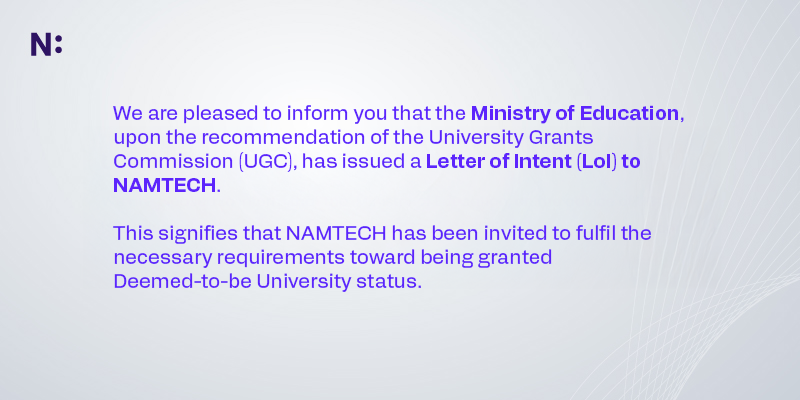
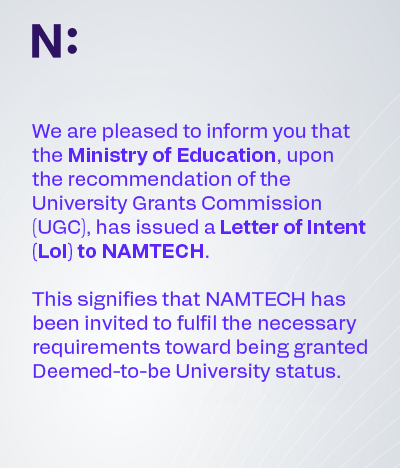
NAMTECH — the New Age Makers’ Institute of Technology — is a not-for-profit institute established by ArcelorMittal Nippon Steel India, operating from the Research Park at IIT Gandhinagar. It offers six two-year master’s programs: Smart Manufacturing, Semiconductor Manufacturing, Robotics Engineering, Sustainability Engineering, Automotive Technology, and Data Analytics & AI — every one of them in a sector from the demand table above. The curriculum is 100% experiential: on-campus micro-factories, Industry 4.0 labs, and a six-month industry internship, backed by globally leading academic and industry partners.
On outcomes: NAMTECH reports 100% placement across its first two graduating batches. For the Smart Manufacturing batch (AY 2024–25), the average package was ₹8.49 LPA, around 50% of the batch was offered above ₹10 LPA, and the highest package was ₹16 LPA.
On cost: total program cost runs approximately ₹13–14 lakh over two years including residence. The India MET Scholarship — available to all eligible applicants with a B.Tech or B.E. and 60%+ marks — covers 50% to 75% of tuition. Girl candidates, graduates from IITs, NITs, IIITs, IISc, IISER, and BITS, and GATE qualifiers qualify for the higher range.
One honest note: NAMTECH began operations in August 2023 and has two graduating batches. Its track record is promising but early. Verify the most recent placement report, check recruiter names against your target sector, and confirm scholarship eligibility in writing before applying.
Three Questions That Decide Your Path
-
Do I want to go deep technically, or toward leadership and management?
Deep technical → M.Tech via GATE or MS abroad in a technical specialization. Management pivot → MBA, ideally after 1–2 years of work. Both → a sector-specific program that combines the two.
-
Do I need to earn within the next year, or can I invest 1–2 years?
Need to earn soon → take the best offer available, but plan your specialization pivot actively from day one. Don’t stay on the commodity track. Can invest → evaluate M.Tech, MBA, MS abroad, or a specialized PG based on question 1 and your financial position.
-
Which sector do I actually want to work in — and is it growing?
Map your branch to the table above. Mechanical → smart manufacturing, automotive, defense, energy. ECE → semiconductors, 5G, aerospace electronics. CSE/IT → AI/ML, cloud, cybersecurity, fintech. Civil → infrastructure. Chemical → green hydrogen, energy. Biomedical → medtech.
If your answer is “whichever pays most,” go back to question 1. The highest-paying outcomes consistently go to people with deep expertise in shortage domains — not to generalists chasing the highest-sounding offer.

30 June, 2026