Announcements
 |
| 

For a long time, the engineering roadmap looked predictable: complete your degree, clear campus placements, join a company, and move up over time. Today, that script has changed. Rapid technological advancement is outpacing traditional academic curricula, while high-growth industries such as semiconductors, robotics, smart manufacturing, and automotive are establishing themselves and looking for multi-talented resources.
Today, companies look for graduates who bring specialised skills, combine technical knowledge with managerial understanding, and are ready to contribute from day one. Students who build this depth early gain a clear advantage. This is why specialised programmes are changing the game, enabling students to move beyond degrees and step confidently into industry-ready roles.
From “A Bit of Everything” to Meaningful Depth
Traditional engineering degrees are designed for breadth. You study many subjects, but often only at an introductory level. By graduation, you may know a little about circuits, mechanics, coding, and systems—but not enough to be considered a specialist in any one of them.
Specialised programmes flip this approach. Instead of covering ten topics lightly, they focus on a single domain and build serious depth. You might spend months immersed in robotics, VLSI design, EV powertrains, or industrial automation.
This shift is more than academic. You move from having “heard of” a concept to being able to design, optimise, and troubleshoot real systems. In hiring and promotion decisions, that kind of depth is what separates a generic profile from a recognised expert.
Hands-On Learning Changes Outcomes
Learning format matters as much as learning content.
Many traditional programmes still rely heavily on lectures and limited lab work. These build theoretical understanding but may not expose you to real-world constraints—failure rates, integration issues, time pressure, or plant-level complexities.
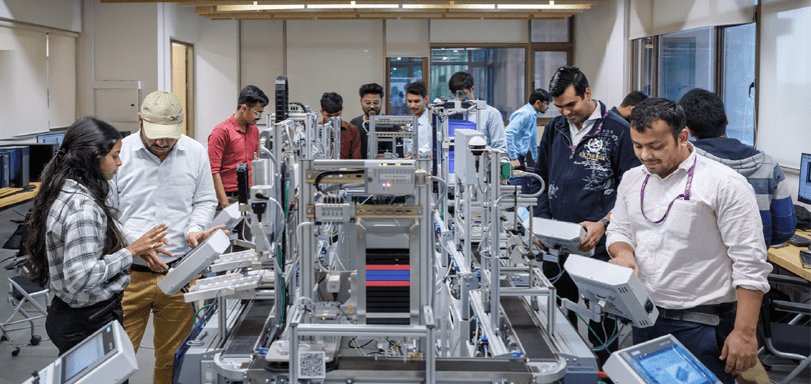
Specialised programmes typically place practical work at the centre. You work with industrial tools, automation lines, robotic arms, semiconductor equipment, and realistic simulations. You design, test, break, and fix systems repeatedly.
This develops technical skill, but also problem-solving instincts, familiarity with modern tools, and the confidence to handle unexpected issues—qualities employers value highly.
Staying Aligned with Industry Needs
Another challenge with broad-based degrees is the slow pace of syllabus updates. By the time a new technology appears in a textbook, industry leaders may already be working on the next generation.
Specialised programmes are often designed with strong industry input. Curricula are reviewed more frequently, and projects, tools, and case studies reflect current practice rather than outdated examples.
For students, this means a smoother transition into the workplace and less time spent “catching up” after joining.
A Clearer return on Investment
A generalist degree often leads to generalist roles, where many graduates compete for similar positions and salary growth can be gradual.
By contrast, specialised competencies prepare you for defined, high-demand niches—such as semiconductor design, industrial automation, or EV systems—where fewer people have the right skills. This can translate into clearer responsibilities, faster learning curves, and stronger growth potential.
A few institutes in India now offer specialised programmes in smart manufacturing, semiconductors, and robotics that go beyond classroom learning, with institutions such as NAMTECH contributing to this shift through specialised programmes designed to shape engineers into techno-managers, professionals who combine strong technical depth with managerial insight. Learning is not just through theory, but through hands-on application, industry immersion, and problem-solving in real-world environments.
With access to experienced faculty, state-of-the-art laboratories, and curricula that evolve in real time with industry needs, such programmes enable engineering graduates to step into specialised roles with confidence, clarity, and long-term career advantage.
Ultimately, the real question is no longer – “Do you have an engineering degree? It is, where is your depth of expertise, and how quickly can you add value?

30 December, 2025