Announcements
Before NAMTECH, I was in a place I think a lot of students (and even working professionals) quietly relate to: a little confused, a little anxious, and not fully sure if my education would actually translate into a job. I had the basics—degrees, theory, maybe a couple of projects—but when I looked at job descriptions, it honestly felt like they were written for someone else. They wanted “hands-on experience,” “industry exposure,” and “cross-functional thinking.” I knew I had potential, but I didn’t have enough proof.
That’s what changed at NAMTECH.
From theory-heavy to industry-focused learning
Traditional learning often teaches you what a system is, but not how it behaves in real life—on a shop floor, inside a plant, or within a fast-moving product company. At NAMTECH, the learning model is built around application. The focus isn’t just on understanding concepts, but on using them the way industry teams do.
Instead of only studying frameworks, we started working on Industry 4.0 and smart manufacturing problems with a practical flow: define the outcome, map constraints, choose tools, test, iterate, and present decisions. That shift—from “knowing” to “doing”—is where confidence starts building.
Labs, tools, and projects that build real confidence
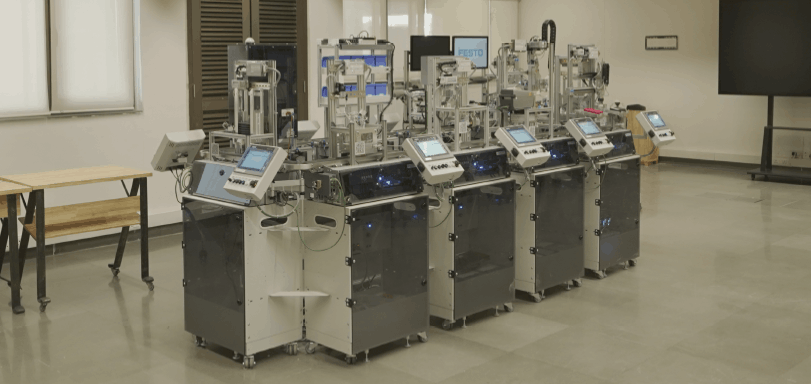
The biggest boost in my confidence came from hands-on training and industry-style workflows. We didn’t just “learn automation”—we worked through automation logic. We didn’t just “study data”—we cleaned it, visualised it, and used it to make decisions.
This is where employability becomes real—because you can actually show what you can do, not just talk about what you’ve studied.
The techno-managerial edge (and why interviews became easier)
One underrated strength of NAMTECH is the techno-managerial approach. Companies don’t only need people who understand technology—they need people who can connect tech to ROI, quality, efficiency, timelines, and risk.
That shift changed how I spoke in interviews:
- Not “I know AI,” but “I used analytics to reduce errors and improve decisions.”
- Not “I did a project,” but “Here was the business problem, my approach, and the measurable impact.”
Additionally, the industry immersion and capstone project taught me teamwork, because you are expected to collaborate across tech, operations, and management, without getting lost in jargon.
Mentors, industry experts, and placement prep that feels practical
Mentorship matters when you’re trying to become job-ready quickly. Feedback from industry professionals helps you stop guessing what “industry-ready” means. And the capstone project becomes proof-of-work—something concrete that demonstrates problem-solving, execution, and communication in one place.
Placement prep also felt genuinely useful: mock interviews, resume refinement, and real-world expectations. You learn how to position your projects, justify choices, and communicate clearly—skills that directly improve employability.
The result: Job-Ready, not just course-complete
By the end, I didn’t feel like I had simply finished a program. I felt career-ready, with stories, projects, and skills that matched what companies actually hire for. And that’s what helped me secure a placement at GE Vernova as a Lean Specialist.
No hype. No luck. Just solid proof that I could deliver in a real role.
– Authored By: Ms. Anmol

06 February, 2026