Announcements
How are AI and machine learning used in robotics engineering?
AI and machine learning in robotics help robots perceive their environment, make decisions and improve with data. Common uses include computer vision for part recognition and quality inspection, bin picking, path planning for mobile robots, predictive maintenance, and learning tasks from demonstration. Together, they let robots handle variation that fixed programs cannot.
What is the difference between traditional and AI-powered robots?
A traditional robot follows a fixed, pre-programmed path and needs a structured environment where parts are always in the same place. An AI-powered robot uses sensors and learned models to detect objects, adapt to changes and make decisions in real time. This makes AI-powered robots better suited to mixed production, logistics and working alongside people.
Why is computer vision important in modern robotics?
Computer vision gives robots the ability to see. It lets them locate and identify parts, check quality, read labels, guide picking and placing, and detect people for safety. Without vision, robots need parts presented in exact positions. Computer Vision and AI is a core subject at the NAMTECH School of Robotics, in its Master Program in Robotics Engineering and Management.
How does machine learning improve robotic decision-making?
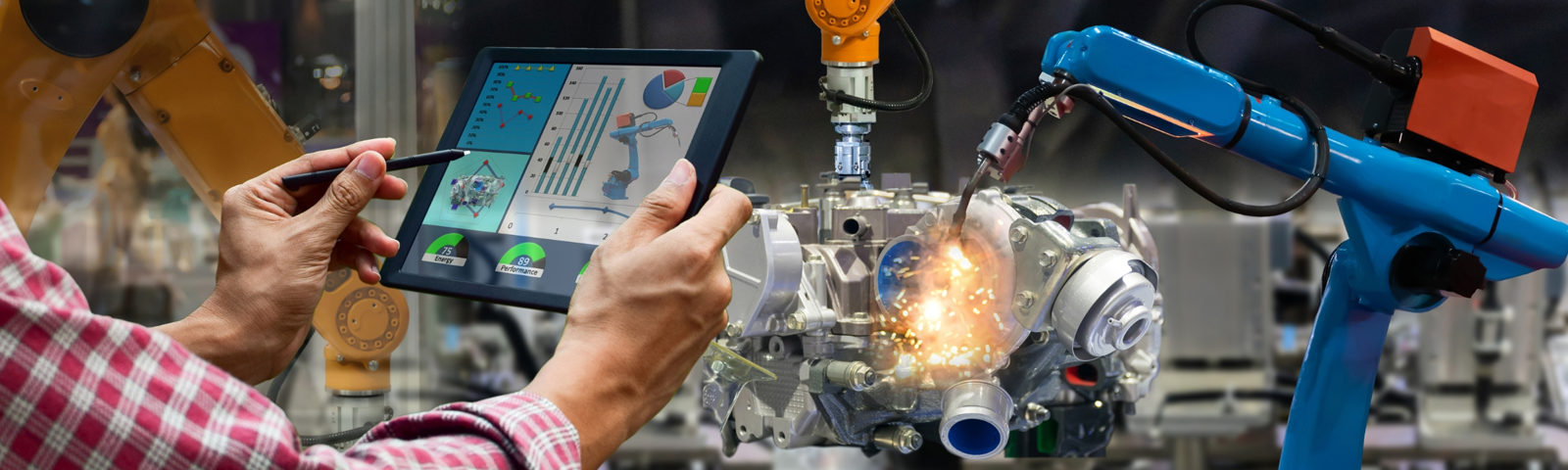
Machine learning trains robots on data instead of hand-written rules. A robot can learn to recognise defects from thousands of images, choose the best grasp for an unfamiliar object, or predict when a component is likely to fail. Over time, models can be retrained on new data, so the robot’s decisions improve as conditions change.
What role does AI play in autonomous robotic systems?
AI is what makes autonomy possible. Autonomous robots, such as warehouse mobile robots, drones and self-driving vehicles, use AI to perceive their surroundings, build maps, localise themselves, plan paths, avoid obstacles and decide on actions without constant human input.
How do robots use sensors and AI to interpret their surroundings?
Robots collect data from cameras, LiDAR, depth sensors, force-torque sensors and encoders. AI models process and combine this data, a technique called sensor fusion, to detect objects, estimate distances, understand the scene and track motion. The result is a model of the environment that the robot uses to plan and act safely.
Which programming skills are required for AI-driven robotics?
Python is essential for AI, machine learning and scripting, and C++ is widely used for real-time robot software. Engineers should know ROS (Robot Operating System), computer vision libraries such as OpenCV, and a deep learning framework such as PyTorch or TensorFlow. NAMTECH robotics students learn Python programming and ROS in the first semester, and leading robotics education in India now teaches these skills as standard.
How is AI transforming industrial automation and manufacturing?
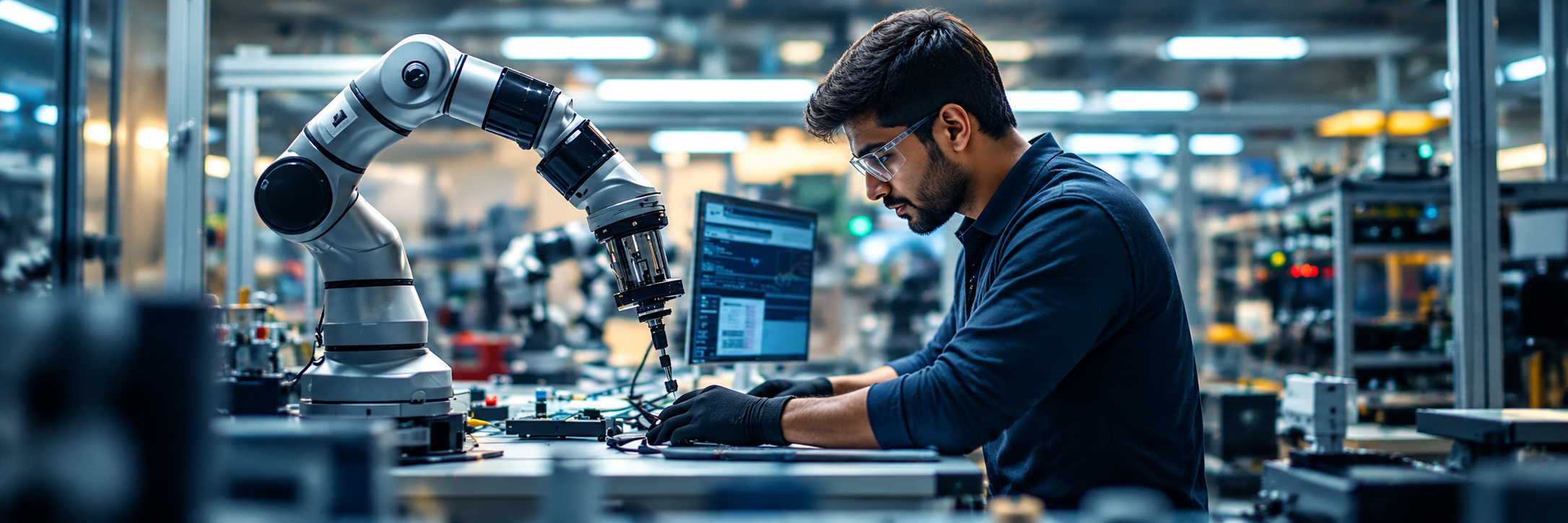
AI is making factories more flexible and data-driven. It powers automated visual inspection, predictive maintenance, adaptive robot cells that handle product variety, collaborative robots that work safely beside people, and optimisation of production and energy use. These are central to Industry 4.0 and smart manufacturing. Industry-academia robotics collaboration, such as NAMTECH’s work with ABB and FANUC, helps students learn these AI tools on real production equipment.
What career opportunities combine robotics, AI and machine learning?
Roles include robotics AI engineer, computer vision engineer, perception engineer, machine learning engineer for automation, autonomous systems engineer, and AI solution designer for manufacturing. Engineers who combine hands-on robotics experience with AI skills are especially valued, because they can take models from the lab to the factory floor.
What ethical and safety concerns arise from AI-powered robots?
Key concerns include physical safety when robots work near people, unpredictable behaviour from AI models, accountability when decisions go wrong, data privacy from cameras and sensors, bias in training data, and the impact of automation on jobs. Engineers address these through safety standards, testing, transparent design and human oversight. NAMTECH’s curriculum includes environment, health, safety and sustainability (EHSS) as a management course.

29 October, 2026