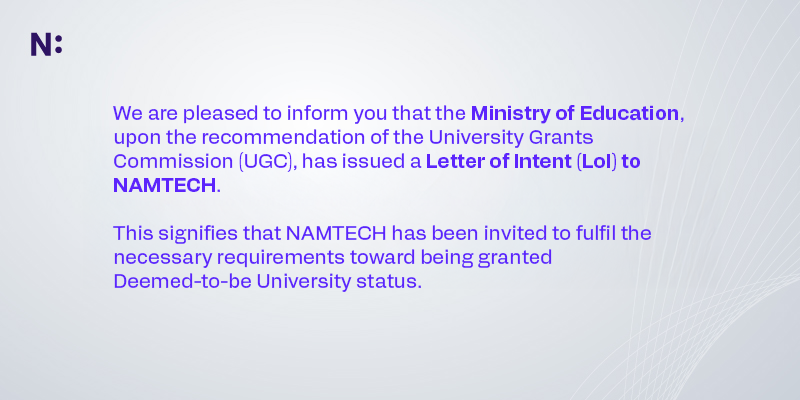
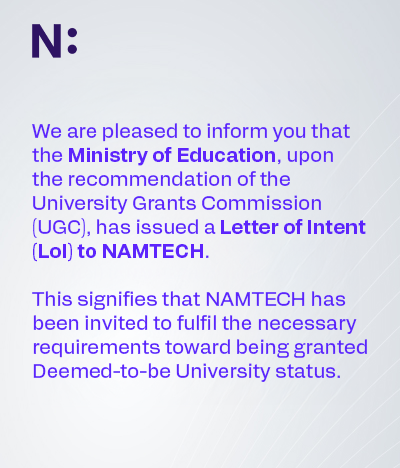
Announcements
What is sustainability engineering and management?
Sustainability engineering and management is a discipline that combines engineering with management to make industries, energy systems and infrastructure cleaner and more resource-efficient. It covers areas such as decarbonisation, renewable energy, circular economy, life-cycle assessment and ESG reporting. The NAMTECH Master Program in Sustainability Engineering and Management, offered by NAMTECH (New Age Makers’ Institute of Technology), is a two-year residential program co-created with KPMG in India and TUM Asia.
How does sustainability engineering differ from environmental engineering?
Environmental engineering mainly deals with treating pollution, for example water and wastewater treatment, air pollution control and waste management. Sustainability engineering is broader and more preventive: it redesigns processes, energy use, materials and value chains to reduce impact from the start, and it adds management skills like ESG reporting, sustainable finance and strategy so engineers can drive change inside companies.
What subjects are covered in a sustainability engineering and management program?
Core subjects at NAMTECH include digital platforms for ESG reporting and certification, industrial emission modelling and decarbonisation, life-cycle assessment (LCA) and circular economy, sustainability tech and AI, renewable energy, energy storage, 3D simulation and digital urban transformation, industrial water management, sustainable infrastructure and transport, and environmental and resource economics. Management courses cover lean, EHSS, project and product lifecycle management, supply chains, finance and strategic leadership.

Who should pursue a master’s program in sustainability engineering?
It suits engineering graduates who want to work on climate, energy and resource challenges, as well as working professionals moving into ESG or decarbonisation roles. NAMTECH says the program is designed for engineering or M.Sc. graduates, with or without work experience, and for professionals who have completed an MBA. Eligible branches include civil, chemical, mechanical, electrical, environmental, energy systems, metallurgy, petroleum and architecture. The program is offered by the NAMTECH School of Sustainability.
What technical and managerial skills does the program develop?
The program builds sustainability skills for engineers on two fronts. On the technical side, students learn emission modelling, LCA, renewable energy and storage systems, energy simulation with AI, industrial water management and digital ESG tools. On the managerial side, they learn lean operations, environment, health, safety and sustainability (EHSS), project management, supply chain management, financial analysis and strategic leadership, along with communication, design thinking and entrepreneurship.
Is sustainability engineering a good career choice in India?
Yes, it is a growing field. India has committed to net-zero emissions by 2070, large companies must now report on ESG, and investment in renewable energy, EVs and green manufacturing is rising. NAMTECH’s program page cites a projection of 7 million green jobs by 2028. Engineers who understand both the technology and the business case are especially in demand, and green skills for engineers are fast becoming a hiring requirement rather than a bonus.
Which industries recruit sustainability engineering graduates?
Graduates are hired by steel, cement, chemicals and heavy manufacturing, power and renewable energy companies, automotive and EV makers, infrastructure firms, consulting and ESG advisory firms, and the public sector. Organisations linked to NAMTECH’s program include ArcelorMittal, AM/NS India, NTPC, GE Vernova, L&T, Schneider Electric, Mahindra, Exide Energy and KPMG in India.

What job roles are available after studying sustainability engineering and management?
Common roles include sustainability consultant, ESG analyst, renewable energy engineer, energy analyst, circular economy strategist, decarbonisation specialist, policy advisor, and sustainability solution designer or implementer. With experience, graduates can move into roles such as sustainability manager or head of ESG.
How does the program prepare students for ESG and net-zero projects?
NAMTECH’s first semester includes Digital Platforms for ESG (reporting, measurement and certification), Industrial Emission Modelling and Decarbonization Pathways, and LCA and Circular Economy. Later semesters add renewable energy, storage and sustainable value chains. Students apply these skills through lab work, a capstone project and an industry internship, working on real sustainability challenges.
What is the future scope of sustainability engineering in India?
The scope is expanding quickly. India’s Net Zero 2070 goal, mandatory ESG disclosures for large listed companies, carbon markets, the push for green hydrogen, renewables and EVs, and export rules on product carbon footprints all need skilled professionals. Sustainability engineers will be needed across manufacturing, energy, infrastructure, finance and policy for decades.

28 October, 2026