Announcements
For Indian B.Tech students aspiring to build a career in manufacturing, understanding the salary landscape is essential for making informed decisions. In 2026, the manufacturing industry in India is undergoing a transformation driven by automation, digitalization, and government initiatives like Make in India and the India Semiconductor Mission. These shifts are influencing salary structures for manufacturing engineers and technicians across the country. This guide provides salary context tailored to the Indian market, with the honest caveat that figures vary significantly by experience, company, location, and specialization — treat ranges as directional, not guaranteed.

Manufacturing Engineer vs. Production Engineer Salaries
Manufacturing engineers in India typically command higher salaries than production engineers due to their involvement in process design, development, and optimization. In 2026, entry-level manufacturing engineers in metro cities like Bengaluru, Pune, and Chennai can expect annual packages ranging from Rs.5 lakh to Rs.9 lakh. Production engineers usually earn between Rs.4 lakh and Rs.7 lakh, with higher salaries at established multinationals or in specialized sectors. Experience and demonstrable technical skills significantly influence where in that range you land.
Salary Ranges for Manufacturing Technicians
Manufacturing technicians — vital for maintaining and troubleshooting production systems — earn between Rs.2.5 lakh and Rs.5 lakh annually, depending on technical skill set, certifications, and location. Technicians with specialized skills in automation or CNC programming typically earn toward the higher end. Certified technicians see a salary uplift compared to those without formal certifications, though the magnitude varies by sector and employer.
How NAMTECH Fits Into the Manufacturing Career Path
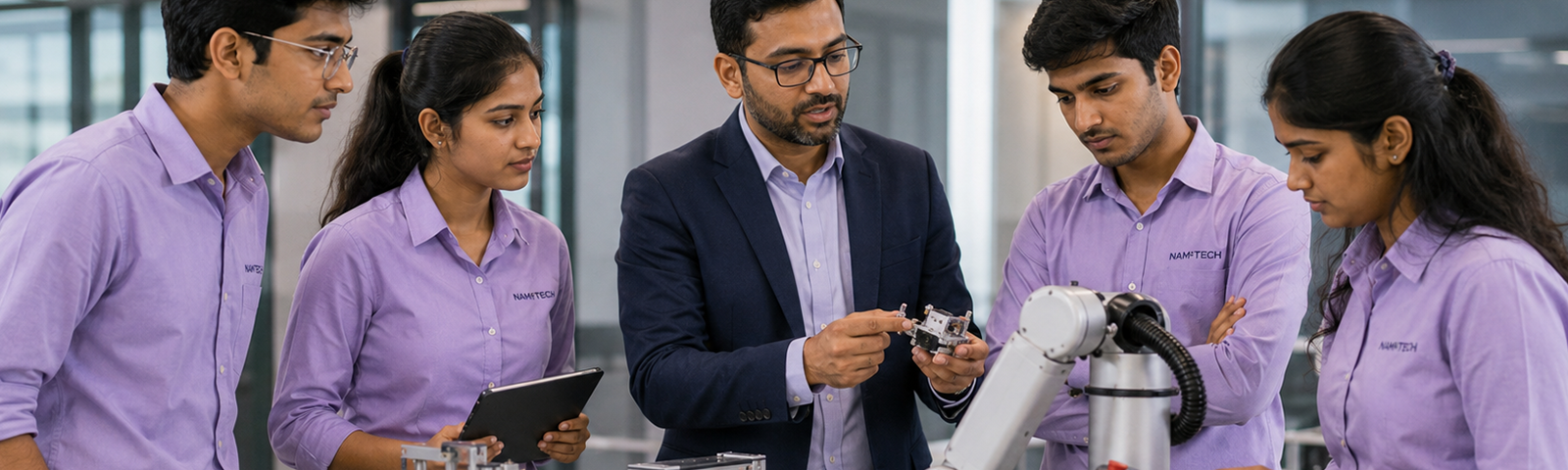
NAMTECH — New Age Makers’ Institute of Technology — is a postgraduate institute founded by ArcelorMittal Nippon Steel India, based at the IIT Gandhinagar Research Park. It runs two-year, full-time, residential master programs in Smart Manufacturing, Semiconductor Manufacturing, Robotics Engineering and Management, Automotive Technology, Sustainability Engineering, Heavy Industry Engineering and Data Analytics & AI.
NAMTECH is not a certification. It is a full two-year master’s-equivalent program designed to produce techno-managers — engineers who combine deep manufacturing technology knowledge with the operational and business leadership skills that advanced manufacturing companies need. The curriculum covers live industry projects, real equipment, supply chain management, and direct recruiter engagement with industry partners including Tata Electronics, CG Power, Micron, Kaynes, Schneider Electric, and ArcelorMittal Nippon Steel.
For students targeting manufacturing leadership roles — plant management, operations, yield engineering, advanced packaging, or supply chain — this is a distinct career track from the B.Tech-plus-certification path. NAMTECH’s placement data from its Smart Manufacturing cohorts shows 100 percent placement over its first two graduating batches, with approximately 41 percent of placed students receiving packages above Rs.8 LPA.
Sector Influence on Manufacturing Salaries
The sector you work in plays a significant role in compensation. Industries investing heavily in automation and advanced manufacturing technologies consistently offer better compensation to attract skilled professionals.
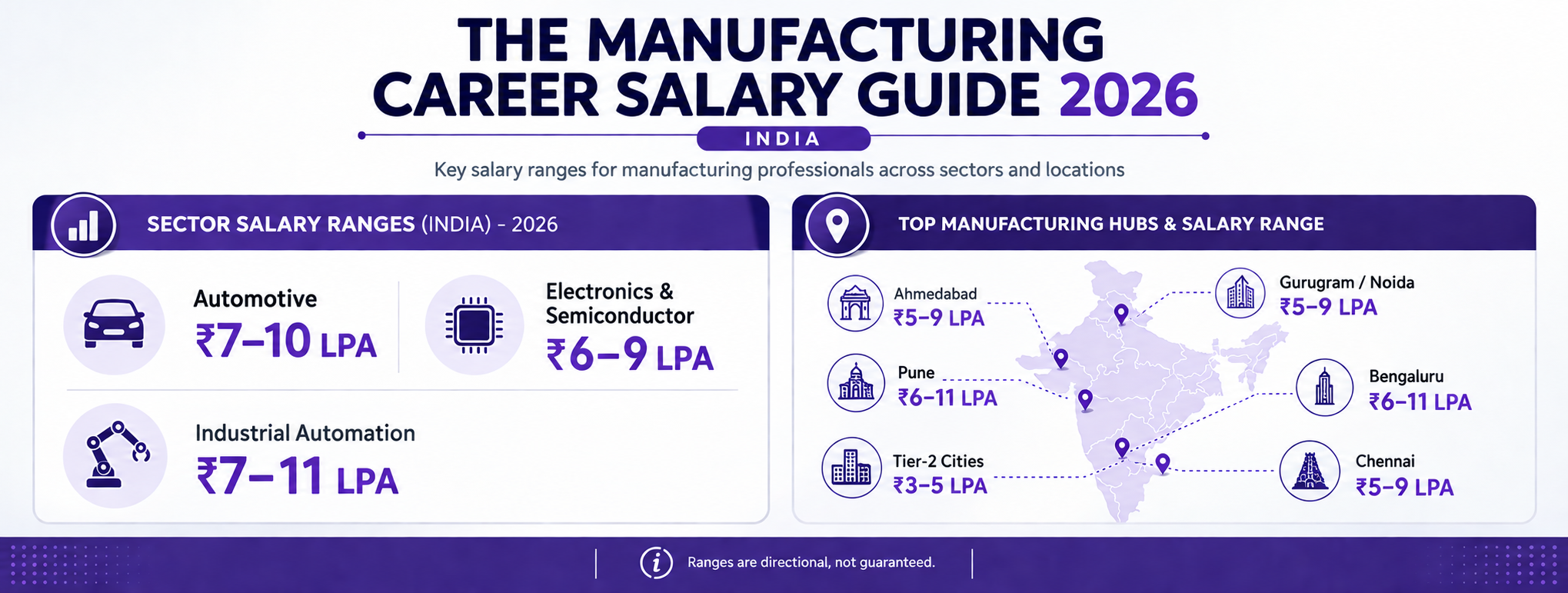
Automotive: One of the highest-paying sectors for manufacturing engineers in India, with mid-level salaries averaging Rs.7 lakh to Rs.10 lakh annually.
Electronics and Semiconductor: Competitive packages averaging Rs.6 lakh to Rs.9 lakh for manufacturing and process roles, with OSAT and fab operations roles opening in Gujarat and Assam as India’s semiconductor mission ramps up.
Industrial Automation: A rapidly growing field commanding Rs.7 lakh to Rs.11 lakh, reflecting the premium placed on automation and robotics expertise. Demand for engineers skilled in PLC programming, robotics, and IoT integration is surging as India’s smart factory push accelerates.
How Location Affects Manufacturing Pay
Metro cities with strong manufacturing hubs — Bengaluru, Pune, Chennai, and Ahmedabad — tend to offer higher packages. Manufacturing engineers in Bengaluru and Pune earn between Rs.6 lakh and Rs.11 lakh per annum. Northern regions including Gurugram and Noida have growing manufacturing sectors with competitive salaries. Smaller cities typically offer Rs.3 lakh to Rs.5 lakh, often offset by lower cost of living.
One emerging geography worth noting: Sanand and Dholera in Gujarat, and Jagiroad in Assam, are becoming significant manufacturing employment centers as semiconductor fabs and OSAT facilities come online. These locations are currently less competitive on cost of living than Bengaluru or Pune, which affects the real-value calculation for engineering roles there.
Career Progression and Salary Growth
Entry-level manufacturing engineers in India typically start at Rs.4 lakh to Rs.6 lakh per annum. With three to seven years of experience, mid-level professionals can command Rs.7 lakh to Rs.10 lakh, particularly with demonstrated expertise in automation or quality management. Senior engineers and management roles at ten or more years of experience often exceed Rs.12 lakh annually, supplemented by performance bonuses.
Certifications such as Certified Manufacturing Engineer (CMfgE) and Lean Six Sigma Green Belt or Black Belt are well-respected and can increase salaries by 15 to 25 percent. For engineers targeting manufacturing leadership rather than technical specialization, a structured postgraduate program that combines engineering depth with operational management — rather than a standalone certification — typically produces a stronger trajectory change.
Emerging Roles and Future Salary Trends
Emerging roles including robotics engineers, AI and data analytics specialists for manufacturing optimization, and IoT engineers are commanding starting salaries in the Rs.8 lakh to Rs.12 lakh range. These positions require strong technical knowledge and continuous upskilling but offer premiums reflecting their role in future-ready manufacturing operations.
Automation technologies are not only transforming job profiles but also raising salary expectations across skill levels. Companies actively seek engineers and technicians with hands-on automation implementation experience, resulting in above-average salary increments compared to traditional manufacturing roles. The engineers best positioned for this market are those who can demonstrate real tool fluency and documented project outcomes — not just a credential list.
FAQ
1. What is the average salary for a manufacturing engineer in India in 2026?
The average annual salary for a manufacturing engineer is approximately Rs.7 lakh, influenced by experience, city of employment, specialization, and industry sector. This is a median figure — the range runs from Rs.4 lakh at entry level in smaller markets to Rs.11 lakh or more for experienced engineers at large multinationals in metro hubs.
2. How do certifications and location affect manufacturing pay?
Certifications like CMfgE and Lean Six Sigma can add 15 to 20 percent to base salary. Location has a significant effect, with metro manufacturing hubs paying meaningfully more than smaller centers. Specialization in automation, robotics, or semiconductor manufacturing commands a premium above the manufacturing median.
3. Is a postgraduate program worth it for manufacturing careers?
For engineers targeting leadership and operations roles — the techno-manager profile — a well-chosen postgraduate program in advanced manufacturing typically produces a stronger ROI than a certification path alone, provided the program is current, project-based, and backed by genuine industry engagement.

05 September, 2026