Announcements
If you look at how hiring is changing in 2026, one thing becomes clear: employers are not only hiring for what you know, they are hiring for how you think, how you adapt, and how fast you can learn and deliver in real situations.
AI is already taking over routine execution. Tools are evolving faster than academic curriculums and job roles are becoming more cross-functional every year.
That is why a new kind of advantage is becoming critical in the workplace: META Skills.
What Are META Skills?
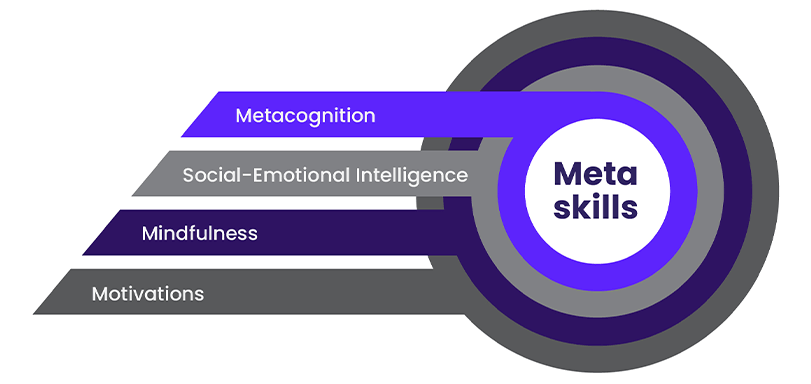
META Skills are high-level skills that help you build and apply other skills. They are the skills that sit above technical knowledge and help you stay effective even when the role, tools, or industry changes.
In simple terms, META Skills are “skills that help you learn, unlearn, and relearn skills.”
For example, learning data analytics is a skill. But being able to learn any new tool quickly, solve unfamiliar problems, work across teams, and make decisions under uncertainty is a META skill advantage.
These are the capabilities that make someone employable not just for one job, but for an entire career journey.
When Was the Term META Skills Coined?
The term “meta-skills” is often linked to the 1990s, especially in career development literature by Hall and Mirvis (1995), where meta-skills were described as “skills for learning how to learn.”
The deeper concept also connects strongly to metacognition, a term coined by psychologist John H. Flavell in 1976, referring to “thinking about thinking” and improving how we learn and make decisions.
So while the language feels modern, the thinking behind it has been relevant for decades and is becoming more important than ever today.
The META Skills That Will Define Employability
META Skills that employers consistently value include learning agility, systems thinking, adaptability, critical thinking, communication clarity, cross-functional collaboration, and ownership.
These skills help professionals stay calm under pressure, understand the bigger picture, communicate decisions clearly, and deliver results even when situations are complex or uncertain.
META Skills vs Soft Skills: What’s the Difference?
Soft skills are often seen as personality-based skills like confidence, teamwork, and speaking ability.
META Skills go one level deeper. They shape how you learn, how you think, and how you operate under pressure. That is why they remain valuable even when industries change.
Why META Skills Are the Need of the Hour
Careers are no longer linear. Most professionals today will not stay in one function forever. People will move across roles, teams, industries, and even career identities.
Those who rely only on degrees and fixed skill sets will feel outdated faster. But those who build META Skills will stay employable because they can learn new tools quickly, adapt to changing roles, make decisions with confidence, connect work to outcomes, and work across teams and industries. META Skills make you useful in any environment.
How Students and Professionals Can Start Building META Skills
You do not need a perfect college or a premium background to build META Skills. You need consistent practice.
Here are simple ways to start:
- Work on real projects, not just theoretical assignments
- Take feedback seriously and improve fast
- Learn how to explain your work in outcomes, not just effort
- Practice collaboration through team-based work
- Build the habit of asking “why” and “what next”
- Reflect on your learning process and improve it over time
Building META Skills Through Education
Today, institutes need to integrate META Skills with technical program to develop multidisciplinary, industry-ready professionals. Institutions like NAMTECH are moving in this direction by embedding design thinking, presentation skills, soft skills into their academic models. More insights into how this approach is being implemented and how it is benefiting students will be shared in upcoming blogs.
Bottom line, META Skills don’t just make you “qualified.” They make you future-ready, someone who can learn fast, think in systems, and deliver outcomes with technology.
Authored By: Ms. Jaya Vadhera

10 February, 2026