Announcements
What is a Master Program in Robotics Engineering and Management?
It is a postgraduate program that combines robotics engineering (kinematics, control, AI, vision and robot programming) with management training in areas like lean operations, project management and supply chains. The NAMTECH Master Program in Robotics Engineering and Management, offered by NAMTECH (New Age Makers’ Institute of Technology) through its School of Robotics, is a two-year, residential program for B.E./B.Tech graduates, designed to produce engineers who can both build automation systems and manage their rollout in industry.
How does robotics engineering differ from robotics management?
Robotics engineering is about building and programming robots: mechanics, sensors, control systems, software and AI. Robotics management is about deploying them well: choosing the right automation, planning projects, managing budgets, safety and supply chains, and leading teams. A combined program like NAMTECH’s teaches both, so graduates can move from the shop floor to techno-managerial roles without a separate MBA. This blend is what sets industry-led robotics education in India apart from purely academic programs.
What subjects does a robotics engineering and management program cover?
Core subjects typically include mathematics for robotics, robot kinematics and dynamics, control, robotic components and integration, Python and ROS, and computer vision and AI. At NAMTECH these run alongside management courses (lean principles; environment, health, safety and sustainability; project management; supply chain management; financial analysis; strategic leadership), professional skills such as design thinking and entrepreneurship, and five electives across semesters two and three.
How long does a master program in robotics engineering and management take?
Most master programs in robotics take two years. NAMTECH’s Master Program in Robotics Engineering and Management runs for two years across four semesters: three semesters of coursework, labs and a first capstone project, followed by a fourth semester dedicated to an industry internship or a second capstone project.
Does the program include practical robotics laboratory training?
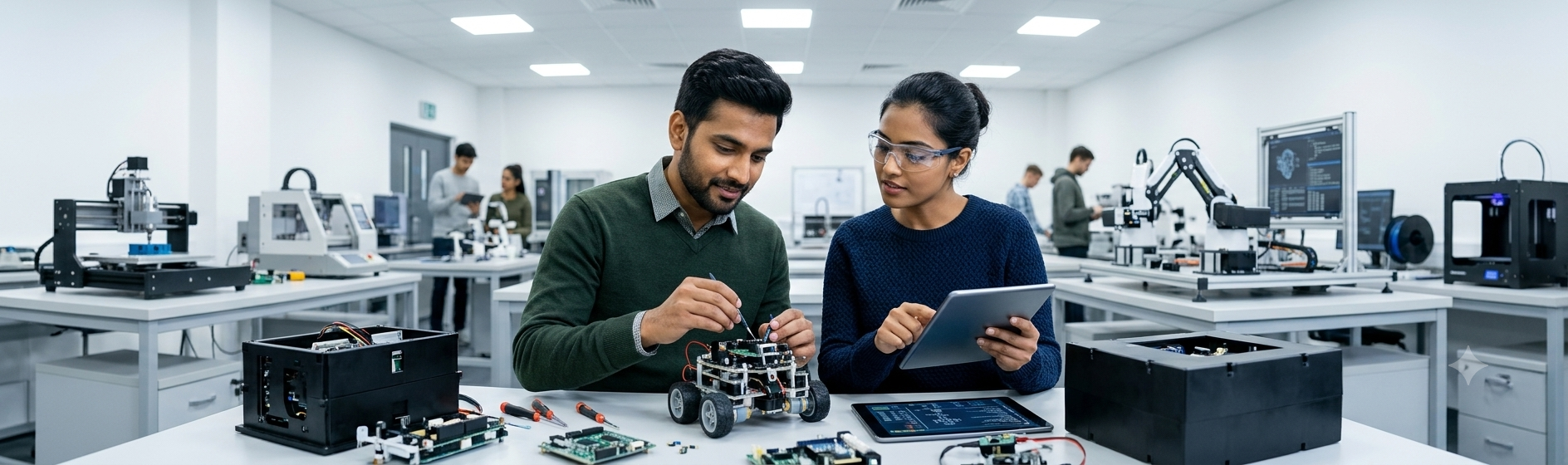
Yes. Practical lab work is central to a good robotics master program. NAMTECH’s program uses advanced labs for collaborative robotics, warehousing robotics, aerial systems and vision-based applications, and it is developed with industry partners including ABB, FANUC, Siemens, Rockwell Automation and Festo. Through the NAMTECH ABB robotics partnership, under which ABB and NAMTECH agreed to set up the NAMTECH School of Robotics, students get direct exposure to industrial robots. They also complete capstone projects on real industry problems.
What management skills do robotics engineering students develop?
Students learn to run automation as a business function, not just a technical one. NAMTECH’s curriculum covers operational excellence through lean principles, environment, health, safety and sustainability (EHSS), project management, supply chain management, financial analysis and strategic leadership. Professional-skills courses add communication, leadership, design thinking, and entrepreneurship and new venture creation.
How are AI and machine learning used in robotics engineering?
AI and machine learning let robots perceive, decide and adapt instead of only repeating pre-programmed motions. They power computer vision for recognising parts, path planning, predictive maintenance, quality inspection and learning from data. In NAMTECH’s program, Computer Vision and AI is a core second-semester subject, alongside Python programming and ROS in the first semester.

Is robotics engineering and management suitable for fresh engineering graduates?
Yes. The program is designed for B.E./B.Tech graduates, and NAMTECH accepts students in their eighth semester as well as those who graduated in the last five years. Work experience in manufacturing and allied domains is encouraged but not required. NAMTECH also states the program suits engineers from non-robotics backgrounds who want to move into automation.
What industries recruit robotics engineering and management graduates?
Robotics graduates are hired across manufacturing, automotive, steel and heavy engineering, electronics and semiconductors, energy, logistics and warehousing, and automation system integrators. Companies listed among NAMTECH’s recruiters include Addverb, Bosch Rexroth, Mahindra, Honda, Hyundai, L&T, Schneider Electric, ArcelorMittal, AM/NS India, Micron, Bharat Forge, Hytech Automation and Gridbots.
What should students consider when choosing a robotics master program?
When comparing any robotics engineering course in India, check five things: how much of the curriculum is hands-on, which industrial robots and labs you will actually use, which companies co-design the program and hire from it, whether there is an internship or capstone with industry, and the total cost against available scholarships. NAMTECH’s program, for example, offers labs built with industry partners, a final-semester internship or capstone, and scholarships of up to 100% of tuition based on merit, interview and family income.

03 November, 2026