Announcements
Thinking about robotics as an undergraduate specialization but not sure what actually separates a strong program from a mediocre one? Here are the questions worth asking before you commit four years to it, answered directly.
Do I need to already know how to code before applying?
No. A well structured robotics program builds programming skills from the ground up, alongside mechanical design, electronics, and control systems. What matters more going in is comfort with math and a genuine interest in how systems work, not prior coding experience.

What subjects actually make up a robotics curriculum?
Expect a mix of mechanical design, electronics and sensors, control systems, programming, and increasingly, machine learning as it applies to perception and decision making in robots. The best programs don’t treat these as separate silos. They teach you how a robotics system actually integrates all of them.
How much hands-on lab work should I expect versus theory?
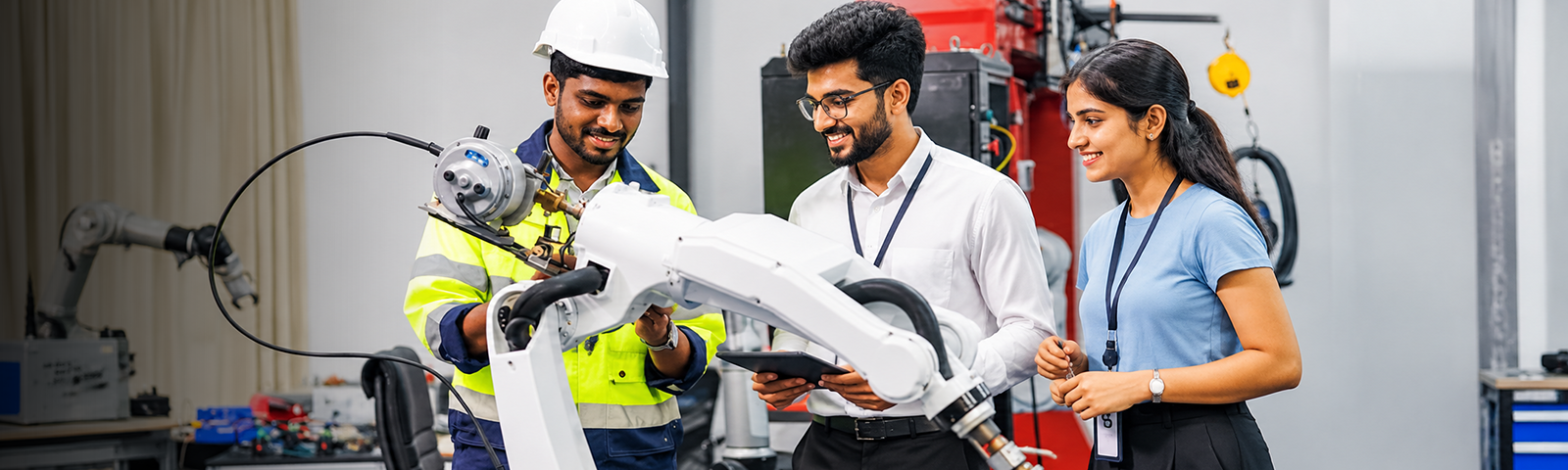
This is one of the biggest differentiators between programs. Robotics is fundamentally a hands-on discipline. If a program is mostly lectures with minimal lab time, you’ll graduate with theoretical knowledge but limited practical ability to actually build and debug systems, which is what employers are hiring for.
What should I look for in terms of industry partnerships?
Look for programs with real, named industry collaborations, not just vague claims of “industry exposure.” Partnerships that involve actual joint projects, guest faculty from companies, or access to industry-grade equipment tell you a lot more than marketing language does.
Is a general mechanical or electronics degree with robotics electives good enough?
It can work, but a dedicated robotics specialization typically gives you deeper, more integrated exposure across all the relevant disciplines rather than a scattered set of electives layered onto a different core degree.
What career paths open up after a robotics undergrad degree?
Manufacturing automation, industrial robotics, autonomous vehicles, agricultural robotics, healthcare robotics, and research roles are all realistic paths, along with further study for students who want to specialize even further.
Where NAMTECH fits in
NAMTECH’s School of Robotics, is built specifically around these criteria: integrated curriculum, heavy lab time, and real industry partnerships rather than occasional guest lectures. It sits within NAMTECH’s broader industry-first model of undergraduate education, and details on applying are available through admissions.
The takeaway
Choosing a robotics program isn’t about finding the one with the flashiest lab photos on its website. It’s about finding one where the curriculum, the lab time, and the industry partnerships are all pointing toward the same outcome: graduates who can actually build and troubleshoot robotic systems on day one of a job, not just describe how they theoretically work.
FAQ
What programming languages are typically taught in a robotics undergrad program?
Commonly Python and C++, along with platform specific tools like ROS (Robot Operating System), though the exact stack varies by program.
Is robotics a good fit for students who are stronger in mechanical subjects than software?
Yes. Robotics genuinely needs both mechanical and software strengths, and a good program lets students develop both rather than requiring mastery of one before starting.
How does NAMTECH’s partnership with ABB actually benefit students?
It provides access to industrial-grade robotics equipment, real-world project exposure, and mentorship from a company that’s a global leader in robotics and automation.
Are there specific companies that recruit from robotics programs like NAMTECH’s?
Recruitment partners vary by cohort and year. Prospective students should check directly with NAMTECH’s admissions team for the current list of recruiting partners.
Can I switch into robotics from a different engineering specialization later?
This depends on the specific program’s transfer policies. It’s best to check directly with NAMTECH admissions about lateral entry options.
How much does lab equipment and hands-on access matter compared to classroom teaching?
Substantially. Robotics is a discipline where hands-on debugging and iteration teach lessons that theory alone cannot, so genuine lab access is one of the most important factors in a program’s quality.

18 November, 2026