Announcements
India’s robotics market reached an estimated $2.14 billion in 2026, up 17% from $1.98 billion in 2025, while industry body NASSCOM has specifically flagged robotics-specific vocational training as underdeveloped nationally. NAMTECH’s School of Robotics, which collaborates with industry leaders ABB, Siemens, and FANUC, is one structured response to that gap, and it shows what a genuine industry partnership can do for robotics talent development.
Why the partnership model matters for robotics talent
India already produces over ten million STEM graduates a year and is the largest non-US contributor to top robotics academic venues, so raw talent supply is not the constraint. What is missing is structured, applied robotics training that turns that supply into a workforce industry can actually deploy, not just publish research with. A robotics program is only as good as the hardware students get to work on and the industry relationships behind it, and that is where ABB’s involvement with NAMTECH’s School of Robotics changes the equation.
How ABB, Siemens, and FANUC support the School of Robotics
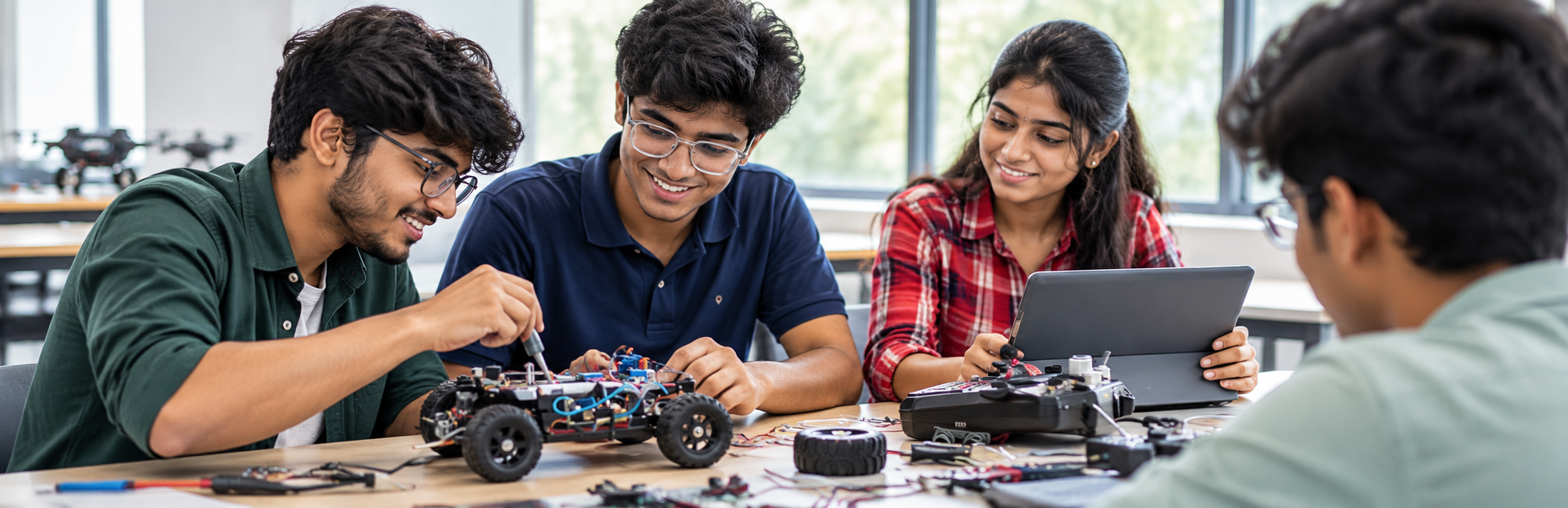
NAMTECH’s School of Robotics collaborates with ABB, Siemens, and FANUC, and these partners have provided equipment and machinery for its labs. That matters because students train on the categories of industrial automation systems these companies actually deploy, not scaled-down simulations alone. Working on real industrial hardware is the difference between a robotics program industry recognises and one it merely tolerates.
The results so far
The 2024-25 cohort of NAMTECH’s Master Program in Robotics Engineering and Management achieved 100% placement across 44 recruiters. That is an outcome measured by employers choosing to hire, not an internal benchmark.
Where NAMTECH fits in
A $2.14 billion market growing at 17% a year needs a workforce that can build, integrate, and maintain the systems driving that growth, not just STEM graduates in the abstract. NAMTECH’s School of Robotics, working with ABB, Siemens, and FANUC, is one structured attempt to close that talent gap; program details are here.
The takeaway
India’s robotics talent gap will not close through market growth alone. It closes when institutes like NAMTECH collaborate with companies such as ABB that are deploying the technology, so students graduate having worked on the systems employers use, not adjacent to them.
Frequently Asked Questions
How is NAMTECH’s School of Robotics shaping India’s robotics talent?
It collaborates with ABB, Siemens, and FANUC, whose equipment and machinery equip its labs, so students train on real industrial automation systems rather than generic coursework.
If the robotics market is growing fast, why is there still a talent gap?
NASSCOM has specifically flagged robotics-specific vocational training, for operators, maintenance technicians, and integrators, as underdeveloped, even though India produces over ten million STEM graduates annually.
What role does ABB play in the School of Robotics?
ABB is one of the industry partners NAMTECH collaborates with, and it supports the school’s labs with equipment and machinery used in real industrial deployments.
Does NAMTECH’s robotics program have measurable outcomes?
Yes. The 2024-25 cohort of the Master Program in Robotics Engineering and Management achieved 100% placement across 44 recruiters.
Is this partnership only relevant to students who want to work at ABB?
No. The 2024-25 cohort was placed across 44 different recruiters, not solely ABB, Siemens, or FANUC.
What should a prospective student look for in a robotics program besides market growth stats?
Named industry partners, verifiable placement and recruiter numbers, and evidence of real hardware and industry-grade projects, not just the word robotics in the program title.

27 November, 2026