Announcements
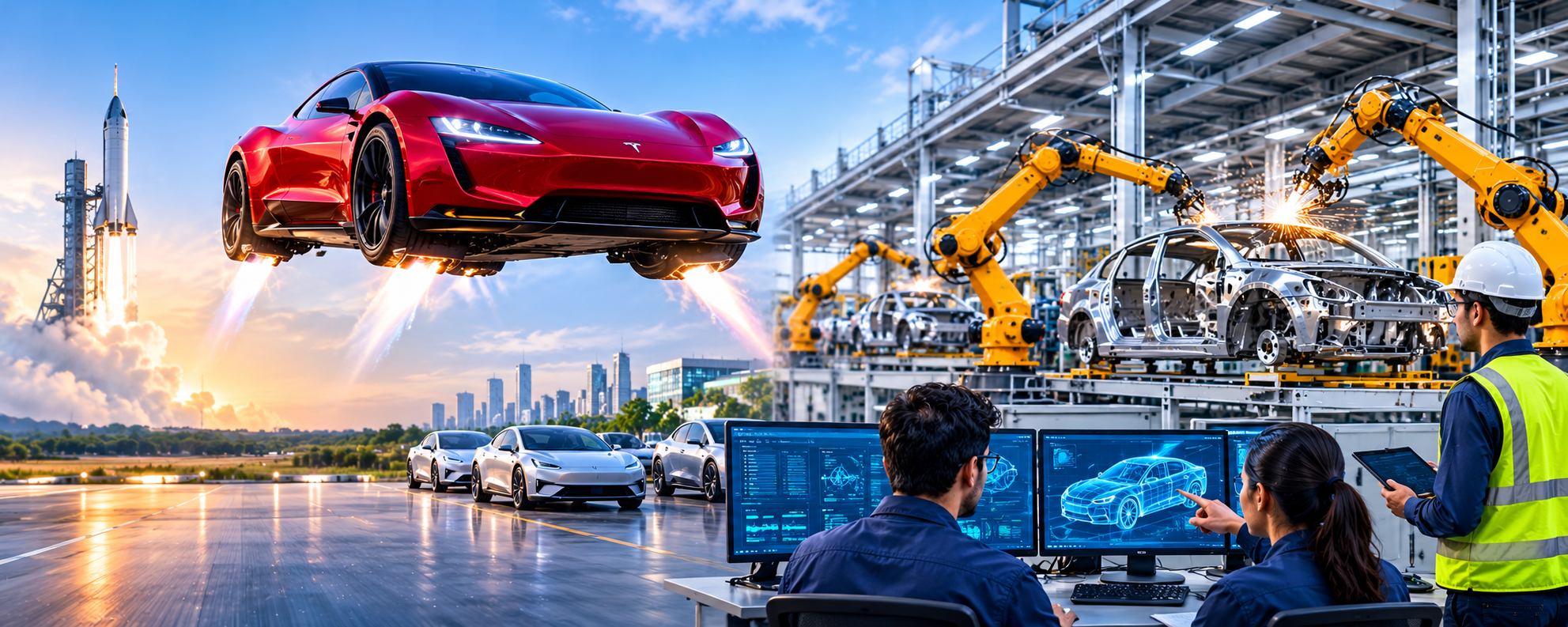
On 15 October 2026, Tesla unveiled its long-awaited second-generation Roadster, a two-seat electric sports car that used cold-gas thrusters to leap into the air at a SpaceX test site in Texas. The internet called it a “flying car”. Engineers saw something else: a showcase of sensors, software, actuators and control systems working together in fractions of a second.
The Roadster will not reach customers before 2028. But the technology behind it, and the factory automation behind Tesla’s other 2026 launch, the driverless Cybercab, tells us a lot about the skills the automotive industry will hire for next. That matters for India, where more than 25 million vehicles are manufactured every year.
What Tesla Showed at the Roadster Launch
The event was held at SpaceX’s rocket test facility near Waco, Texas, after a planned 1 October date was pushed back. Tesla’s executives said they borrowed SpaceX technology to build the car’s party trick.
- Cold-gas thrusters and suction: high-pressure air thrusters and a multi-mode suction system let the car climb a curved ramp, hang upside down, flip and land.
- The jump: the Roadster used its thrusters to leap over a parked Cybercab, Cybertruck, Tesla Semi, Model Y and Model 3.
- Acceleration: Tesla showed it reaching 0–60 mph in about one second.
- No driver on board: the stunt was run without anyone in the car, for safety.
- Trims and timeline: three trims, reservations open now, production planned for 2028.
Tesla itself calls the Roadster a halo car, a product meant to show what its engineering can do rather than to sell in volume. Musk has also admitted it is not a safety-optimised car. So the real lesson for students is not the jump. It is the control engineering that makes the jump possible: sensing the car’s position, firing actuators at the right millisecond and keeping a moving car stable mid-air.
The Quieter Launch: Cybercab and the “Unboxed” Factory
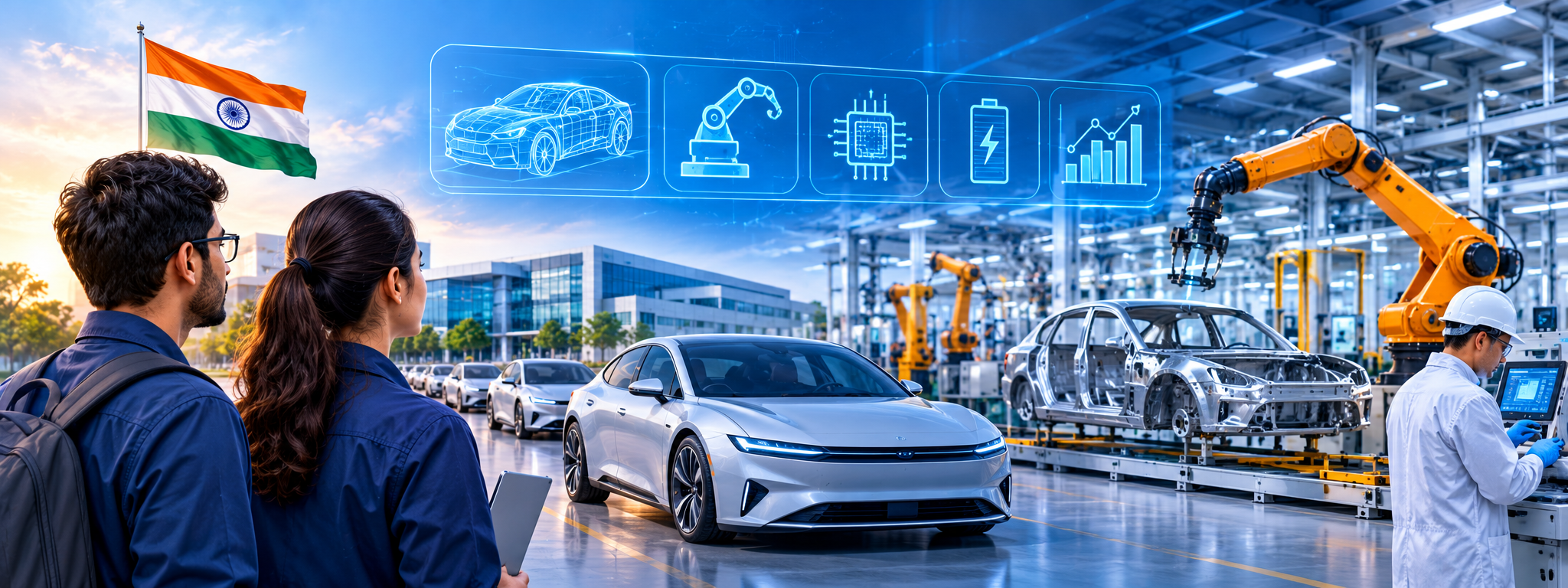
While the Roadster grabbed headlines, Tesla’s bigger 2026 story happened on the factory floor. The Cybercab, a two-door robotaxi with no steering wheel or pedals, built its first production unit at Gigafactory Texas in February 2026. Formal production began in April, and Tesla started paid public rides in Austin in September 2026.
What makes the Cybercab interesting for engineers is how it is built. Tesla calls it the “unboxed” process:
- Instead of one car moving down a single long assembly line, major sections of the vehicle are built in parallel.
- Each module is assembled and finished on its own.
- The modules are locked together at final assembly, with far fewer steps than a conventional line.
Tesla says the approach cuts factory floor space and cost, and can be reconfigured quickly. Musk has talked about an eventual cycle time of under 10 seconds per vehicle, and has also warned that the early ramp would be slow. Whether or not that target is reached, the direction is clear: the next generation of car plants will look more like electronics factories, run by robots, sensors and data.
Why Tesla’s Launches Are Really an Automation Story
Both launches run on the same idea: machines that sense, decide and act on their own. The difference is only where that happens.
| Where automation shows up | Roadster | Cybercab |
| In the vehicle | Thrusters and suction fired by control software in real time | Fully driverless operation using Tesla’s self-driving computer and cameras |
| In the factory | Low-volume, high-precision build (from 2028) | High-volume “unboxed” modular assembly with heavy robotics |
| Core skills behind it | Control systems, sensors, actuators, vehicle dynamics | Industrial robotics, PLC-based automation, line design, data and AI |
In short, the car is becoming a robot on wheels, and the factory that builds it is becoming a robot too. Engineers who understand both sides, the vehicle and the plant, will be the ones carmakers compete to hire.
What This Means for Automotive and Manufacturing Careers in India
India has more than 350 million vehicles on its roads and builds over 25 million a year, across two-wheelers, three-wheelers, cars and commercial vehicles. Indian carmakers and component suppliers are adding electric models, driver-assistance features and more automated plants. The question for young engineers is not whether Tesla-style technology arrives here, but whether they will be ready to build and run it.
Three shifts stand out:
- From mechanical to mechatronic: today’s vehicle is as much electronics and software as engines and chassis. Roles such as ADAS engineer, battery engineer and software-defined vehicle (SDV) specialist are growing.
- From manual lines to smart factories: modular assembly, robotic welding, automated quality checks and digital twins need people who can programme, maintain and improve automated systems.
- From doing to managing: plants need techno-managers who understand the technology and can also run projects, supply chains and teams.
This creates openings at two levels: engineering graduates who want to design and lead, and ITI or diploma holders who want to become skilled technologists on the shop floor.
The Skills Behind the Headlines
Strip away the thrusters and the robota xi, and you find a set of skills any engineer can learn:
- Industrial automation: PLCs, SCADA, sensors, pneumatics and drives — the backbone of any automated line.
- Industrial robotics: programming, integrating and maintaining robots for welding, painting, handling and assembly.
- Electric vehicle technology: batteries, motors, power electronics and battery assembly.
- ADAS and autonomous systems: cameras, sensor fusion, functional safety and automotive cybersecurity.
- Smart manufacturing: design for manufacturing, digital twins, IIoT, lean operations and modular line design.
- Data and AI: using production and vehicle data for predictive maintenance, quality and self-driving software.
- Techno-management: project management, supply chain and product lifecycle management to turn technology into output.
From Watching Tesla to Building It: Where NAMTECH Fits In
Tesla’s two launches show three layers of the same story. There is the vehicle, a robot on wheels. There are the robots that build it. And there is the factory, which runs on automation, data and chips. A career in any of these layers is within reach for an Indian engineer or technician. Where you start depends on where you are today, and NAMTECH is built to take you from that starting point into the layer you want to work in.
Two starting points, one destination
If you are a B.E. or B.Tech graduate, your next step is depth plus the ability to lead. Each NAMTECH Master Program pairs a technology with management, because the industry needs people who can build the technology and run the projects, teams and supply chains around it.
- Drawn to the car itself, its EV powertrain, driver-assistance features and autonomy? The Master Program in Automotive Technology and Management is the closest match to Tesla’s world. It runs through the Centre of Excellence in Automotive Engineering, and its curriculum is being developed with support from CAAR at IIT Madras. It covers Hybrid and Electric Vehicles, ADAS and Autonomous Vehicles, Automotive Cybersecurity and Smart Automotive Manufacturing. Mini factories for body-in-white, vehicle assembly and battery assembly are being set up to give hands-on practice in Cybercab-style processes.
- More curious about the robots that weld, handle and assemble those cars in parallel? The Master Program in Robotics Engineering and Management, from the School of Robotics set up with ABB, trains you to design, programme and manage them.
- Think the “unboxed” factory is the bigger story? The Master Program in Smart Manufacturing Technology and Management at the School of Manufacturing Technologies focuses on how modular, Industry 4.0 plants are planned and run.
- Fascinated by the data that lets a car drive itself and a plant fix itself? The Master Program in Data Analytics & Artificial Intelligence, linked to the Centre of Advanced Computing & AI, builds AI skills for industrial use.
- Interested in what sits inside every one of those systems? The Master Program in Semiconductor Manufacturing Technology and Management prepares you for India’s growing chip industry.
If you are an ITI or diploma holder, you don’t need a degree to work on Tesla-style lines. Automated plants depend on skilled technologists who keep robots and PLC-controlled lines running every shift. The International Professional Technologist Program (iPTP) is a 12-month residential program designed with ITE Education Services (ITEES), Singapore. Its Automation and Industrial Robotics tracks take you from your trade or diploma to a technologist’s role in automated manufacturing.
Frequently Asked Questions
What did Tesla launch in October 2026?
Tesla unveiled its second-generation Roadster on 15 October 2026 at a SpaceX test site in Texas. The electric sports car uses cold-gas thrusters and suction to briefly lift off the ground, reaches 0–60 mph in about one second, and is planned for production in 2028.
Is the new Tesla Roadster really a flying car?
Not in the usual sense. Its thrusters give it short bursts of lift for jumps and flips, but it cannot fly from place to place. It is best seen as a showcase of control systems, sensors and actuators working together.
What is Tesla’s unboxed manufacturing process?
It is a way of building cars where major sections are assembled in parallel and joined at the end, instead of on one long moving line. Tesla uses it for the Cybercab to save floor space and cost, and it relies heavily on robotics and automation.
How is automation changing car manufacturing in India?
Indian automakers are adding robotic welding, automated quality checks, EV battery lines and data-driven plants. This is raising demand for engineers and technologists skilled in industrial automation, robotics, EV technology and smart manufacturing.
Which NAMTECH course is best for a career in EVs and autonomous vehicles?
The NAMTECH Master Program in Automotive Technology and Management covers hybrid and electric vehicles, ADAS and autonomous vehicles, automotive cybersecurity and smart automotive manufacturing, with hands-on mini factories for vehicle and battery assembly.
Can I build a career in automation after ITI or a diploma?
Yes. NAMTECH’s International Professional Technologist Program (iPTP) offers Automation and Industrial Robotics tracks for ITI and diploma holders, designed with ITEES Singapore, to prepare technologists for automated manufacturing plants.

06 November, 2026