Announcements
Can students pursue a Master’s in Robotics after completing B.Tech?
Yes. A master’s in robotics after B.Tech is one of the most common routes into automation, and a B.Tech is the standard entry qualification. The NAMTECH Master Program in Robotics Engineering and Management is designed specifically for B.E./B.Tech graduates, and accepts students in their eighth semester as well as those who graduated in the last five years.
What are the eligibility requirements for a Master’s in Robotics?
For NAMTECH’s program, you need a B.E./B.Tech from an eligible branch with at least 60% marks (or 6.0/10 CGPA) in 10th, 12th and graduation, and no active backlogs. A CAT, XAT, GMAT, GRE or GATE score is preferred. Open school students are not eligible. Admission involves an online application, a Statement of Purpose and an interview.
Which B.Tech branches are accepted for robotics master’s admission?
NAMTECH accepts B.E./B.Tech graduates in Mechanical, Computer Science, Information Technology, Manufacturing, Electrical, Electronics, Electrical & Electronics, Instrumentation & Control, Robotics, Industrial, Automobile and Aeronautical Engineering.
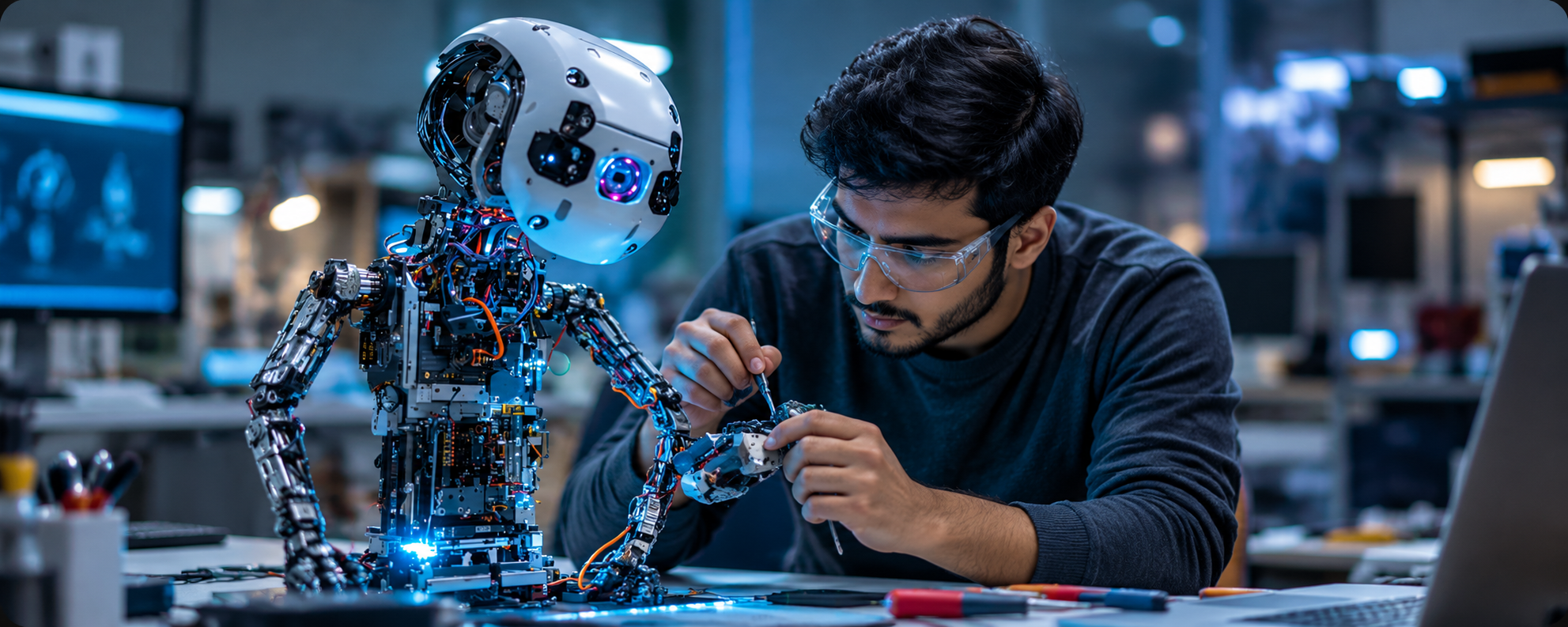
What subjects are taught in a Master’s in Robotics Program?
In NAMTECH’s program, semester one covers mathematical concepts for robotics, industrial manipulators and robot kinematics, robotic components and integration, and Python programming and ROS. Semester two adds computer vision and AI, robot dynamics and control, and electives. Semester three includes more electives and a capstone project. Management and professional-skills courses run throughout, and semester four is an internship or capstone.
Does a robotics curriculum include Python programming and ROS?
It should. Python is the most widely used language for robotics scripting and AI, and ROS (Robot Operating System) is the standard framework for building robot software. At NAMTECH, Python Programming and ROS is a core first-semester subject, so students build this foundation before moving on to vision, AI and control.
Are internships and capstone projects included in robotics Programs?
In most industry-focused programs, yes. At NAMTECH, students complete Capstone Project (A) in semester three, and the entire fourth semester is set aside for an industry internship or Capstone Project (B). These projects are built around real problems from industry, giving students work they can show employers.
What career options are available after a Master’s in Robotics?
Graduates work as robotics engineers, automation specialists, system integrators, AI developers, solution designers and implementers, and fault diagnostics engineers. With the management training in NAMTECH’s program, graduates can also grow into project and operations leadership roles in manufacturing and automation.

What skills do employers seek in robotics engineering graduates?
Employers look for hands-on experience with industrial robots and PLC-based automation, programming (Python, ROS), computer vision and AI, systems integration, and troubleshooting. They also value project management, safety awareness, communication and the ability to work across mechanical, electrical and software teams, which is why NAMTECH pairs its technical curriculum with management and professional-skills courses. Good robotics skill development in India now combines technical and managerial skills in one program.
Can a Master’s in Robotics lead to opportunities in Industry 4.0?
Yes. Robotics is one of the core technologies of Industry 4.0, alongside IoT, AI and data-driven automation. Graduates can work on smart factories, automated warehouses, connected production lines and digital manufacturing. NAMTECH describes its robotics curriculum as Industry 4.0-aligned, and NAMTECH ABB FANUC robotics training, developed with partners such as ABB, FANUC, Siemens and Rockwell Automation, gives students hands-on experience with industrial robots.
Is a Master’s in Robotics a suitable option after mechanical engineering?
Yes, it is one of the most natural progressions. Mechanical engineers already understand mechanisms, dynamics and manufacturing; a robotics master’s adds programming, electronics, control and AI. This combination is in demand for robot integration, automation design and smart manufacturing roles. Mechanical Engineering is an eligible branch for NAMTECH’s program.

31 October, 2026