Announcements
For most of the last two decades, the standard Indian mechanical engineering graduate has faced a specific structural disadvantage in the job market. Computer science graduates entered a rising software industry with directly applicable skills. Mechanical graduates entered a stable manufacturing industry with skills that had a longer half-life but a lower ceiling. That trade-off looked stable until recently.
It is no longer stable. The single most important shift in engineering hiring over the past three years is that mechanical engineers who can also work with data have started commanding compensation closer to what computer science graduates earn, while retaining the manufacturing career trajectory that pure computer science graduates cannot access. The hybrid profile is now the most valuable one in advanced manufacturing.
This piece is about what that hybrid looks like, why it commands the premium it does, and how a mechanical engineer builds it.
What “talking to data” actually means
“Data” is a fuzzy term. Inside a modern manufacturing environment, it has three specific components.
Sensor and process data. Every piece of equipment on a modern factory floor generates continuous streams — vibration signatures on motors, temperature and pressure on chemical processes, cycle times on CNC machines, torque profiles on assembly robots. This data is the raw material for anomaly detection, predictive maintenance, and yield analysis.
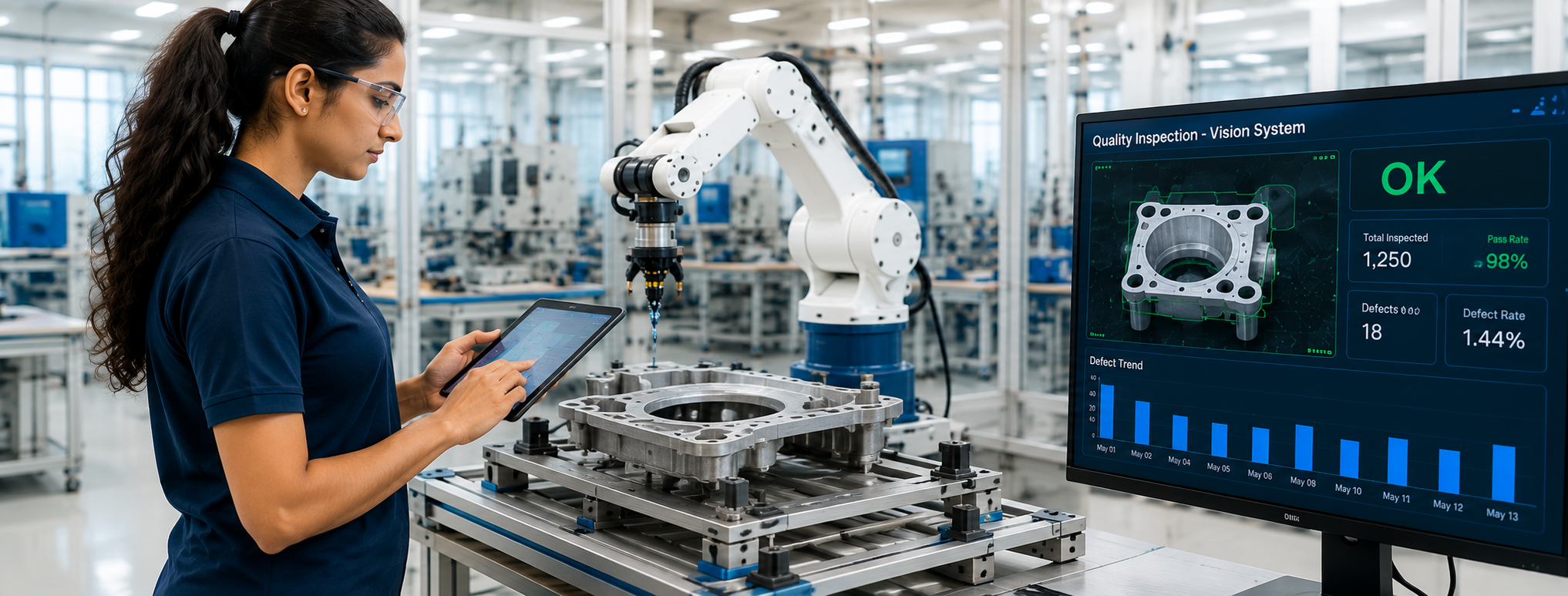
Quality and inspection data. Increasingly generated by computer vision cameras rather than manual inspectors. Defect classifications, dimensional measurements, surface-quality signatures — all captured and stored automatically.
Business systems data. Production plans, materials requirements, order backlogs, energy consumption, cost allocations. Traditionally the domain of operations and finance teams; increasingly integrated with the shopfloor systems above.
A mechanical engineer who can talk to data is one who can move fluently across all three — reading sensor streams for predictive maintenance signals, interpreting vision-inspection outputs for process control, and connecting shop floor observations to production and cost decisions.
The specific skills
The skill stack for this hybrid profile is more specific than “learn Python.” Four capabilities matter.
Statistical thinking applied to physical processes. Statistical process control, design of experiments, root-cause analysis. This is the layer where the mechanical-engineering foundation meets the data layer directly, because reading data on a physical process without understanding the physics is a shortcut to wrong conclusions.
Programming for engineering data. Python is the standard. Libraries: pandas for manipulation, NumPy for numerical work, scikit-learn for classical machine learning, matplotlib and Plotly for visualization. MATLAB is still valued in some sectors, especially controls and signal processing. SQL for querying production databases.
Domain-specific analytical tools. SCADA data historians (OSIsoft PI, AVEVA, Ignition), MES analytics modules, and vendor-specific tools inside Rockwell FactoryTalk, Siemens Xcelerator, and PTC ThingWorx. The important point about these tools is that they are how the data is actually accessed in most production environments — not as clean CSVs but through vendor-specific APIs.
Machine learning fundamentals applied to production problems. Predictive maintenance is a classic supervised learning problem. Yield analysis is a mix of statistical and machine-learning techniques. Computer-vision quality inspection is deep learning. A mechanical engineer does not need to be a machine-learning specialist to work in these areas — but does need to understand what a model is doing well enough to work with a data scientist as a peer.
Why the compensation premium exists
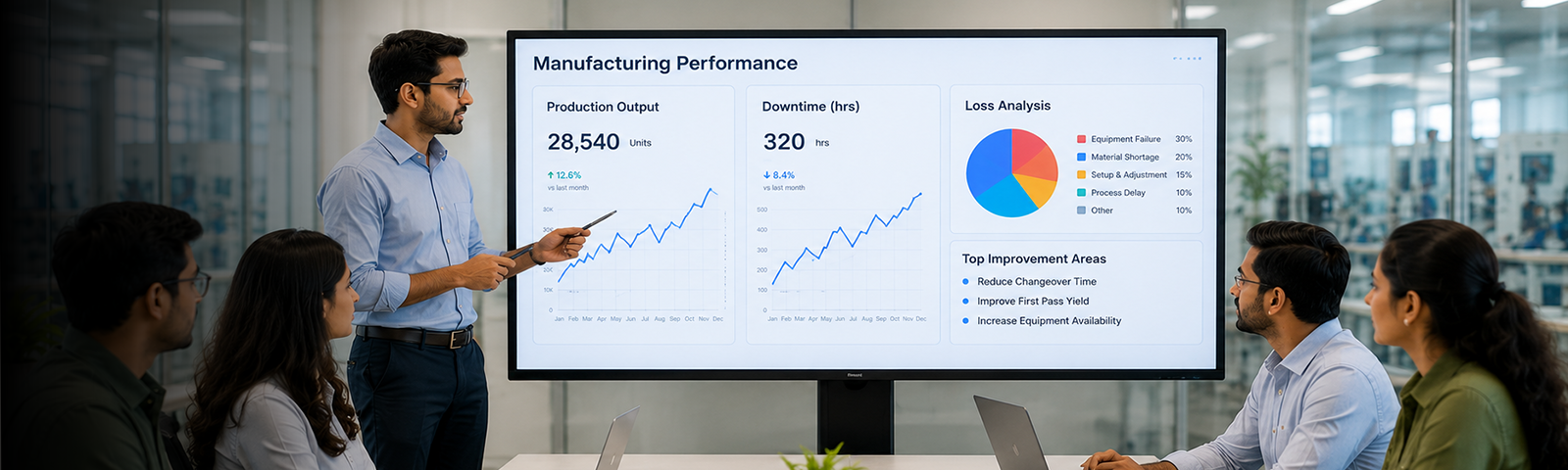
The compensation gap between a plain mechanical engineer and a data-literate mechanical engineer has a straightforward explanation: the roles that pay well in advanced manufacturing require both engineering judgment and data fluency, and companies cannot fill them by hiring either kind of specialist alone.
FindMyCollege’s 2025 analysis, drawing on Ambition Box data, made the point directly: a mechanical engineer with Python and MATLAB, or an electrical engineer with IoT and embedded skills, can command salaries close to CSE freshers. Medicaps University’s analysis put mechanical engineers with IoT, AI, or smart-manufacturing skills in the ₹3-18 LPA band; the upper end is not achievable with a plain B.Tech.
The World Economic Forum’s Future of Jobs Report 2025 identified big data specialists, AI and machine-learning specialists, and — importantly — autonomous and electric vehicle specialists and renewable energy engineers among its top 15 fastest-growing roles globally through 2030. The last two categories are hybrid roles by definition. They are staffed by engineers who understand physical systems and can work with data on those systems.
The India Skills Report 2026 found that 64% of employers now treat AI, data science, and cybersecurity skills as premium talent regardless of the college a candidate attended. That premium extends to engineering graduates in adjacent disciplines who have added these skills to their profile.
What this looks like in a career
Concretely: a data-literate mechanical engineer in Indian manufacturing today is one of five or six things.
A process engineer at a semiconductor fab or OSAT running yield analysis and statistical process control on wafer-level data. Micron, Tata Electronics, Kaynes Semicon are hiring for this profile.
A predictive maintenance engineer at a heavy-industry plant, monitoring equipment health signals and preventing unplanned downtime. ArcelorMittal, L&T, Tata Steel, JSW are the anchor employers.
A quality engineer with computer vision at an automotive or electronics plant, working with vision-inspection systems and reducing defect rates. Bosch, Schneider, Foxconn contract manufacturers hire this profile.
A manufacturing analyst at a smart factory, sitting inside a plant’s data team and translating shop-floor observations into cost and throughput improvements. Ola Electric’s Futurefactory, Tata Motors’ EV plants, and Reliance-BP battery operations are examples.
A techno-manager running a production line or plant, using data as a management tool to allocate resources, plan production, and make trade-off decisions. Plant managers at Glassdoor median ₹15.5 LPA and 6figr average ₹21 LPA; technical program managers at Levels.fyi average ₹52 LPA.
How the hybrid gets built
A B.Tech in mechanical engineering, on its own, does not build this profile. Most Indian mechanical curricula spend enough time on thermodynamics, machine design, and manufacturing processes to leave graduates capable — but not enough time on programming, statistics, or industrial data systems to make them data-literate.
Closing that gap can happen in one of three ways. Self-study — plausible for the top decile of motivated graduates, difficult for everyone else because the industrial data tools are not accessible outside industrial environments. On-the-job learning — real but slow, and mostly available at large employers who invest in internal upskilling. Structured postgraduate training — the fastest path when the program is designed around the hybrid.
NAMTECH’s Master in Smart Manufacturing Technology and Management and Master in Data Analytics and AI programs are specifically designed to build the hybrid profile at scale. The Rockwell Automation partnership (NAMTECH Annual Report 2025) covers integration of Rockwell’s industrial-automation e-learning modules into the curriculum. The 2.008N program, adapted from MIT’s course 2.008 Design and Manufacturing II, gives students hands-on experience running a design-to-production cycle with data integration at every stage.
The read
The economic logic of the hybrid profile is not going to reverse. Manufacturing is going to become more data-driven, not less. The compensation premium for engineers who can work across the physical and data domains will grow, not shrink. This is not a trend prediction — it is the direct implication of the WEF, Team Lease, and India Skills Report data on where hiring demand is moving.
For a mechanical engineer finishing a B.Tech, the decision is not whether to add data literacy to the profile. It is how quickly, and through which route. The engineers who do it in the next two years will enter the highest-paying part of Indian manufacturing at the moment when it is being built. The ones who do not will enter it a decade later, at a discount.

11 September, 2026