Announcements
At NAMTECH, social impact is not an add on. It is embedded in how we design education, engage with industry, and prepare the next generation of skilled professionals.
India’s manufacturing and technology sectors are evolving rapidly. To ensure this growth is inclusive and sustainable, it is essential that access to advanced skills, quality education, and employment opportunities reaches those who have traditionally been left behind.
Through Creating Social Impact Together, NAMTECH invites corporates, foundations, and CSR partners to support initiatives that deliver measurable outcomes in education, employability, gender equity, and workforce readiness.
Areas to Support
NAMTECH currently has two high impact social initiatives where corporate support can create meaningful and lasting change.
Projects
Women in Manufacturing (WiM) Scholarship
Manufacturing is central to India’s long term economic vision under Viksit Bharat 2047. Yet women remain significantly underrepresented in technical and shop floor roles, with participation estimated at below 20%.
Financial barriers, limited access to advanced technical education, and persistent social constraints prevent many capable young women from entering and thriving in manufacturing careers. At the same time, industry faces an increasing demand for skilled talent in automation, robotics, digital manufacturing, and Industry 4.0 technologies.
The Initiative
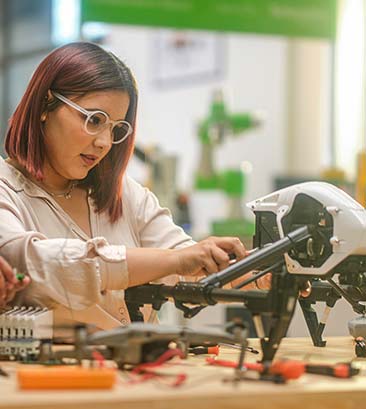
The Women in Manufacturing (WiM) Scholarship addresses both challenges by enabling deserving women to access advanced manufacturing education while strengthening India’s industry ready talent pipeline.
The program aims to:
By investing in women engineers today, we contribute to a more inclusive, competitive, and resilient manufacturing ecosystem.
The WiM Scholarship supports:

SDG 4
Quality Education through expanded access to advanced technical learning

SDG 5
Gender Equality by increasing women’s representation in manufacturing

SDG 8
Decent Work and Economic Growth by enabling skilled, stable employment
For corporate partners, the initiative strengthens ESG commitments while contributing to a gender diverse, industry aligned talent pipeline.
ITI Industry 4.0 Skills Transformation Program
India trains nearly 2 million students annually across approximately 15,000 Industrial Training Institutes. Despite this scale, fewer than 40% secure employment aligned with their training, and many begin their careers with limited earning potential.
Outdated curricula, minimal exposure to automation and robotics, and weak industry linkage restrict ITI graduates, particularly those from rural and semi urban communities, from accessing future ready manufacturing roles.
As India accelerates its manufacturing ambitions, closing this skills gap is both a social and economic necessity.
The Initiative
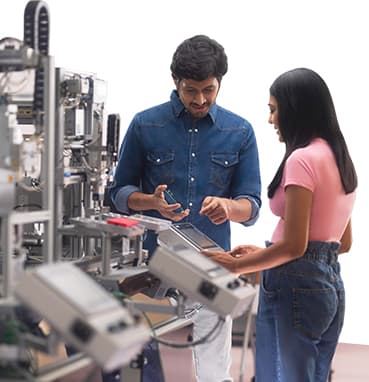
NAMTECH’s ITI Outreach Program modernises Government ITIs in the Mehsana cluster of Gujarat through a scalable Hub& Spoke model, delivering hands on, Industry 4.0 aligned training.
Key elements of the program include:
Strong Institutional Foundation
The capital expenditure required to establish state of the art Industry 4.0 Smart Labs across the 5 Hub ITIs has been supported by ICICI Foundation. This ensures that the physical infrastructure and advanced lab facilities are already in place.
Student Support Initiative
India’s vision for a technologically advanced and self-reliant future depends on nurturing skilled engineers in emerging fields such as Smart Manufacturing, Artificial Intelligence, and Industry 4.0. However, for many talented students, financial hardship remains a critical barrier to completing high-quality technical education.
Students from economically vulnerable backgrounds, especially those without a stable family income or financial guarantors, often face rejection from traditional education financing systems. As a result, even high-performing and industry-ready candidates risk being unable to complete their education despite proven merit and commitment.
The Initiative
The NAMTECH Scholarship Fund – Student Support Initiative aims to bridge this gap by supporting deserving students who demonstrate academic excellence, resilience, and strong career potential, but lack the financial means to complete their education.
This initiative ensures that financial constraints do not prevent capable students from transitioning into skilled professionals who contribute to India’s industrial and technological growth.
Case Spotlight: Ram
A first-generation technology student enrolled in the Smart Manufacturing and AI program, Ram represents the very purpose of this initiative.
Despite losing his father at a young age and growing up in a household with no salaried income, he has demonstrated exceptional determination and academic excellence.

Reasons to Support:
Ram has exhausted all formal financial avenues and now faces one final barrier: Paying his remaining tuition fees.
The Program Aims To:
Disclaimer : The name used in this appeal has been changed to protect the individual’s identity. Verified information can be accessed on Benevity.
How You Can Contribute
NAMTECH actively welcomes CSR funding, grants, and philanthropic donations from corporates and foundations committed to education, skills development, and social inclusion.
Support may be directed towards:

Scholarships and student financial assistance

Training delivery and certification

Faculty development & curriculum enhancement

Mobility outreach and Lab on Wheels operations

Placement facilitation and employability outcomes
We also encourage long term partnerships, employee volunteering, mentoring, and strategic collaboration.
Transparent and Trusted Giving Channels
To ensure ease, compliance, and transparency, NAMTECH is registered on two globally recognised CSR aligned platforms:

Through these platforms, organisations can review our initiatives, understand impact areas, and choose how best to contribute.
Together, we can create meaningful and measurable social impact.
To contribute to our cause, kindly reach out to us at corporate_partnerships@namtech.ac.